
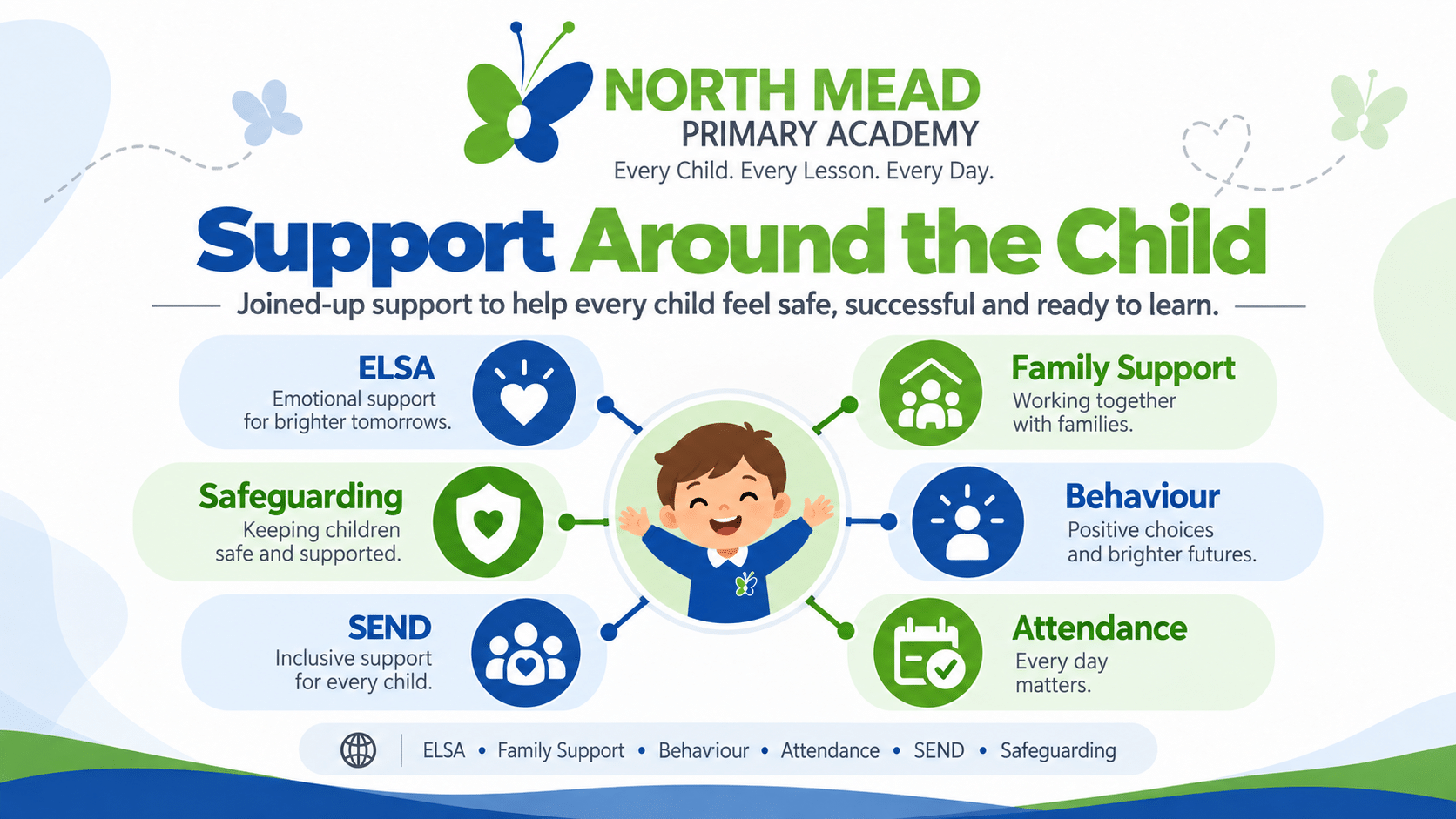
Helping children feel safe, understood and ready to learn
At North Mead, pastoral support is a central part of our commitment to Every Child. Every Lesson. Every Day.
Children learn best when they feel safe, known, valued and emotionally ready to engage. Our pastoral offer is designed to identify barriers early, strengthen relationships and provide practical support so that children can attend, participate and succeed.
Pastoral support is not separate from learning. It helps create the conditions in which learning can happen.
Pastoral support at North Mead
Our pastoral approach is built around five connected priorities.
- Know
We build strong relationships so that children feel known and adults notice when something changes.
- Listen
We give children opportunities to talk, communicate concerns and feel heard.
- Support
We provide practical, emotional and relational support matched to the child’s needs.
- Connect
We work closely with families, teachers, SEND, attendance, safeguarding and external agencies.
- Review
We check whether support is making a difference and adjust it where needed.
Our aims
Through pastoral support, we aim to:
- help children feel safe and secure
- strengthen emotional wellbeing
- support self-regulation
- improve readiness to learn
- build confidence and resilience
- strengthen relationships
- support positive behaviour
- improve attendance and engagement
- identify concerns early
- help children communicate worries
- reduce barriers to participation
- work effectively with families
- connect children and families with wider support where needed
Early help matters
We believe difficulties are best addressed as early as possible.
A child may need additional pastoral support because of:
- emotional wellbeing
- anxiety or worry
- friendship difficulties
- behaviour
- regulation
- bereavement or loss
- family change
- attendance difficulties
- SEND
- communication needs
- low confidence
- transition
- difficulties outside school
- safeguarding concerns
- wider family pressures
Children do not need to reach crisis point before support is considered.
Our pastoral offer
Support is matched to individual need and may include:
- trusted-adult check-ins
- ELSA support
- Behaviour Mentor support
- Family Support Worker involvement
- attendance support
- emotional regulation work
- friendship and social support
- restorative conversations
- transition support
- individual plans
- family meetings
- referrals and signposting
- support from external agencies
The aim is always to provide the right help, at the right time, for the right reason.
ELSA support
Our Emotional Literacy Support Assistant helps children who may need additional support with emotions, relationships, confidence or change.
ELSA work may support children with:
- recognising and naming emotions
- emotional regulation
- anxiety
- confidence
- self-esteem
- friendships
- social understanding
- bereavement or loss
- transitions
- problem-solving
Support is usually focused, purposeful and reviewed to make sure it is helping the child.
Behaviour Mentor support
Our Behaviour Mentor provides additional support for children who need help with:
- regulation
- routines
- relationships
- engagement
- behaviour
- reflection
- conflict
- re-establishing positive patterns
The purpose is not simply to respond to behaviour after something has gone wrong.
We aim to understand what the behaviour is communicating, teach more successful strategies and help children re-engage positively with learning and relationships.
Family Support Worker
Our Family Support Worker works alongside families where wider circumstances may be affecting a child’s wellbeing, attendance or readiness to learn.
Support may include:
- family routines
- parenting challenges
- attendance
- behaviour
- housing difficulties
- financial pressures
- accessing services
- referrals
- appointments and meetings
- liaison with professionals
- transition
- practical signposting
- support during periods of family difficulty
We recognise that supporting the family can often be an important part of supporting the child.
Attendance support
Attendance and pastoral support work closely together.
Where attendance begins to decline, we aim to understand the barrier rather than simply focus on the percentage.
Support may include:
- early conversations with families
- individual attendance plans
- trusted-adult support
- morning check-ins
- support with routines
- SEND adjustments
- pastoral intervention
- home-school communication
- gradual reintegration where appropriate
- liaison with external professionals
Our approach is supportive and persistent.
Emotional regulation
Some children need explicit support to recognise and manage strong emotions.
We may support children to:
- identify emotions
- recognise triggers
- understand physical signs of dysregulation
- use calming strategies
- communicate needs
- ask for help
- repair relationships
- return to learning
Adults aim to co-regulate first and gradually help children develop increasing independence.
Trusted adults
Strong relationships are one of the most important protective factors in school.
Some children benefit from a named trusted adult who can:
- check in regularly
- listen
- notice changes
- reinforce routines
- help with regulation
- support transition into learning
- provide consistency
The aim is not to create dependence, but to help children feel secure enough to become increasingly independent.
Friendship and social support
Children may need help to develop and maintain positive peer relationships.
Support can include:
- friendship work
- social skills
- turn-taking
- perspective-taking
- resolving disagreement
- understanding boundaries
- repairing relationships
- recognising healthy and unhealthy behaviour
Where appropriate, restorative approaches help children understand impact and rebuild relationships.
Behaviour and pastoral support
Behaviour is supported through clear expectations, strong relationships and consistent routines.
Where a child needs more support, we consider:
- what happened before the behaviour
- what the behaviour may be communicating
- whether there are unmet needs
- patterns over time
- SEND
- communication
- regulation
- relationships
- attendance
- family circumstances
This does not remove accountability.
Children are supported to understand expectations, take responsibility, repair harm and learn more successful ways to respond.
Pastoral support and SEND
Pastoral and SEND support are closely connected.
Some children with SEND may experience additional challenges with:
- communication
- sensory processing
- regulation
- social understanding
- anxiety
- transitions
- emotional literacy
Support is adapted so that children can access it meaningfully.
We avoid assuming that behaviour is simply deliberate when there may be an underlying communication or regulation need.
Pastoral support and safeguarding
Pastoral work can sometimes reveal safeguarding concerns.
Staff understand that pastoral conversations must never replace safeguarding procedures.
If a child shares information that suggests they may be at risk of harm, staff:
- listen carefully
- avoid leading questions
- record the concern
- report it immediately through safeguarding procedures
Adults do not promise confidentiality.
Safeguarding always takes priority.
Supporting transitions
Transitions can be difficult for some children.
We may provide additional support when children:
- start Nursery or Reception
- move between year groups
- change teachers
- join North Mead during the year
- move into or out of additional provision
- return after a period of absence
- prepare for secondary school
- move to another setting
Support may include:
- extra visits
- photographs
- visual information
- social stories
- trusted-adult support
- meetings with families
- information sharing
- additional check-ins
Working with families
Strong pastoral support depends on strong relationships with families.
We aim to:
- communicate early
- listen carefully
- understand the wider context
- agree practical next steps
- avoid unnecessary blame
- maintain high expectations
- review support together
- celebrate progress
Families are encouraged to speak to us early if they are worried about their child.
Bilingual support
Where needed, bilingual staff can help families:
- understand school information
- communicate concerns
- take part in meetings
- understand support plans
- access services
- navigate referrals
We want language barriers to be reduced wherever possible.
Working with external professionals
Where school support alone is not enough, we may work with:
- Educational Psychology
- Speech and Language Therapy
- Occupational Therapy
- SEMH services
- health professionals
- Early Help
- social care
- specialist teaching services
- local authority teams
- other community services
External advice helps strengthen support and ensure children and families receive appropriate help.
Pastoral support in the classroom
Pastoral support is not only delivered by named pastoral staff.
Every adult contributes through:
- consistent routines
- warm relationships
- noticing changes
- calm responses
- clear boundaries
- high expectations
- listening
- encouragement
- helping children regulate and re-engage
A strong pastoral culture is created through everyday interactions.
Pupil voice
Children need to feel that support is being done with them, not simply to them.
Where appropriate, children are asked:
- what is difficult
- what helps
- who they trust
- what they would like to change
- whether support is working
Their views help shape the support they receive.
How we know pastoral support is working
We review pastoral support using evidence such as:
- pupil voice
- attendance
- engagement in learning
- behaviour patterns
- emotional regulation
- relationships
- participation
- confidence
- family feedback
- teacher feedback
- progress against individual targets
We do not judge impact simply by whether an intervention has taken place.
We ask:
- What has changed for the child?
- What success looks like
Successful pastoral support should help children become increasingly able to:
- feel safe in school
- communicate concerns
- regulate emotions
- build positive relationships
- attend more regularly
- engage with learning
- recover from setbacks
- ask for help
- solve problems
- take responsibility
- participate confidently
- become more independent
Most importantly, we want children to know: “There is an adult here who knows me, listens to me and will help me.”
Who supports children and families?
Our pastoral and inclusion team includes colleagues with responsibilities for:
- ELSA
- family support
- behaviour
- attendance
- SEND
- safeguarding
Families can speak to their child’s class teacher or contact the school if they are unsure who is best placed to help.
Our commitment
At North Mead, pastoral support is about more than responding when something goes wrong.
It is about creating a school where children are: known, valued, supported and ready to learn.
Belong. Participate. Succeed.
Every Child. Every Lesson. Every Day.
NM – Inclusion and Early Help Handbook
Related North Mead Pages
- Inclusion
- SEND
- Attendance
- Safeguarding
 Together We Make A Positive Difference