Preparing children for life
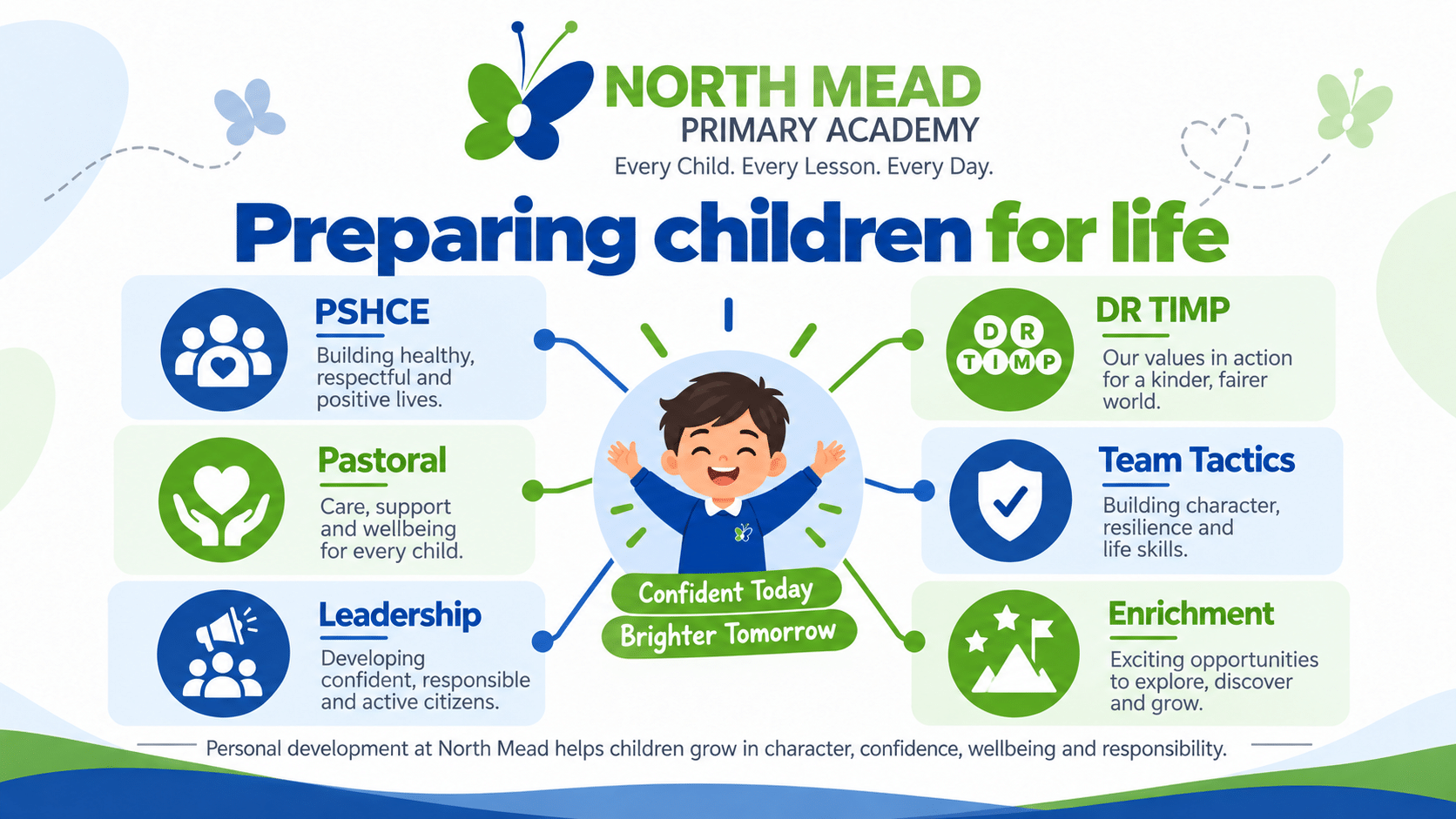
At North Mead, Personal Development is about helping children become confident, responsible, respectful and resilient young people who understand themselves, others and the world around them.
It is not taught through one lesson alone.
Personal Development runs through:
- PSHCE
- assemblies
- relationships and behaviour
- safeguarding
- enrichment
- pupil leadership
- attendance
- inclusion
- sport
- arts and culture
- curriculum experiences
- wider school life
Our aim is to ensure children leave North Mead with strong academic foundations and the knowledge, attitudes and character they need for the next stage of their lives.
Our approach
Personal Development at North Mead is built around six connected areas.
- Relationships
Children learn how to build healthy, respectful relationships.
- Character
Children develop resilience, responsibility, reflection and confidence.
- Citizenship
Children learn how communities, democracy, law and responsibility work.
- Safety and wellbeing
Children learn how to keep themselves and others safe and healthy.
- Opportunity
Children experience leadership, culture, sport, creativity and the wider world.
- Aspiration
Children develop confidence in their future and understand that their circumstances should not limit their ambition.
DR TIMP
Our Personal Development curriculum is underpinned by DR TIMP.
- D — Democracy
Children learn:
- that people can have different views
- how decisions can be made fairly
- how voting works
- how pupil voice can influence school life
- why participation matters
- R — Rule of Law
Children learn:
- why rules and laws exist
- how they protect people
- the difference between rights and responsibilities
- why actions have consequences
- why fairness matters
- T — Tolerance
Children learn to respect people whose:
- beliefs
- cultures
- experiences
- traditions
- backgrounds
- may be different from their own.
- I — Individual Liberty
Children learn:
- how to make choices
- how to express opinions respectfully
- how to understand personal freedom
- how freedom exists alongside responsibility
- how to recognise unsafe pressure or influence
- M — Mutual Respect
Children learn to:
- listen
- disagree respectfully
- value others
- understand impact
- treat people with dignity
- repair relationships when things go wrong
- P — Protected Characteristics
Children learn age-appropriately about equality and protected characteristics and why discrimination is unacceptable.
Team Tactics
Our wider approach to character and learning is reinforced through Team Tactics.
Children learn to be:
- Be Ready
- Be Respectful
- Be Responsible
- Be Reflective
- Be Resilient
- Show Reciprocity
These qualities are reinforced through lessons, assemblies, behaviour, teamwork, leadership and everyday school life.
What children learn
| Phase | What children learn |
| EYFS | Emotions, relationships, routines, independence, sharing, turn-taking, simple rules, asking for help and understanding belonging. |
| KS1 | Friendship, families, feelings, safety, respect, responsibility, community, simple democracy, trusted adults and healthy choices. |
| Lower KS2 | Equality, protected characteristics, online safety, boundaries, consent, bullying, democracy, responsibility, resilience and wider community. |
| Upper KS2 | Increasingly complex relationships, puberty and change, risk, influence, discrimination, citizenship, financial awareness, aspiration and transition to secondary school. |
Relationships
Children learn about:
- friendship
- family
- respect
- boundaries
- trust
- cooperation
- consent
- conflict
- repair
- healthy and unhealthy relationships
They learn that good relationships require both kindness and responsibility.
Behaviour and relationships
Personal Development is closely connected to behaviour.
Children are supported to understand:
- expectations
- consequences
- impact
- responsibility
- repair
- self-regulation
- reflection
We want children to do more than simply comply.
We want them to understand why respectful behaviour matters.
Equality and diversity
Children learn that people are different and that difference should be understood and respected.
Our curriculum includes:
- protected characteristics
- race
- religion and belief
- disability
- sex
- different families
- culture
- identity
- prejudice
- discrimination
We teach children to challenge stereotypes and understand why discrimination is harmful.
Safeguarding through Personal Development
Children are taught how to keep themselves safe.
This includes:
- trusted adults
- personal boundaries
- consent
- unsafe situations
- online safety
- bullying
- child-on-child abuse
- road safety
- water safety
- harmful content
- grooming
- exploitation
- how to seek help
Children are regularly reminded that they should speak to an adult if something does not feel right.
Online safety
Personal Development includes learning about:
- privacy
- passwords
- digital footprints
- online relationships
- gaming
- social media
- scams
- harmful content
- cyberbullying
- manipulation
- misinformation
- reporting concerns
The same expectations of respect and responsibility apply online as offline.
Health and wellbeing
Children learn about:
- physical health
- mental health
- sleep
- exercise
- healthy eating
- hygiene
- emotions
- regulation
- relationships
- asking for help
Older pupils learn about puberty and growing up in an age-appropriate way.
Emotional literacy
Children are helped to:
- recognise emotions
- name emotions
- understand triggers
- communicate feelings
- use regulation strategies
- ask for help
- reflect
- recover after setbacks
This work is supported by our wider pastoral offer, including ELSA.
Resilience
Resilience does not mean expecting children to cope alone.
We teach children to:
- persevere
- manage setbacks
- try again
- reflect
- seek support
- adapt
- solve problems
- recognise progress
Resilience grows through successful experiences, strong relationships and appropriate support.
Leadership and pupil voice
Children should experience what it means to contribute.
Opportunities may include:
- pupil leadership
- environmental leadership
- supporting younger pupils
- representing the school
- helping at events
- contributing to decisions
- pupil voice
These experiences develop:
- confidence
- communication
- responsibility
- teamwork
- decision-making
Citizenship
Children learn that they are part of communities.
This includes:
- school
- local community
- Leicester
- the United Kingdom
- the wider world
- They learn about:
- rights
- responsibilities
- democracy
- law
- fairness
- community
- contribution
- service
- sustainability
Careers and aspiration
Primary-aged children should begin to understand the range of possibilities available to them.
Through curriculum, visitors, enrichment and discussion, children encounter:
- different jobs
- different pathways
- different skills
- role models
- future possibilities
We want pupils to understand that their background should not determine their future.
Financial understanding
Children progressively learn about:
- money
- spending
- saving
- choices
- needs and wants
- value
- responsibility
Older pupils begin to develop greater awareness of financial decision-making.
Enrichment and cultural development
Personal Development extends beyond lessons.
Through the Fantastic Fifty and wider enrichment, children experience:
- sport
- music
- art
- theatre
- museums
- places of worship
- outdoor learning
- cultural events
- community experiences
- performances
- visitors
- leadership
These experiences broaden horizons and strengthen cultural understanding.
Fundamental British Values
North Mead actively promotes:
- democracy
- the rule of law
- individual liberty
- mutual respect
- tolerance of those with different faiths and beliefs
These are taught through DR TIMP, PSHCE, assemblies, RE, behaviour, curriculum and wider school life.
Protected characteristics
Children are taught about protected characteristics in an age-appropriate and respectful way.
This supports pupils to:
- recognise discrimination
- understand equality
- challenge stereotypes
- respect difference
- understand that everyone has equal worth
This work is woven across PSHCE, assemblies, RE and the wider curriculum.
Personal Development through assemblies
Assemblies provide a regular opportunity to revisit important themes.
These may include:
- DR TIMP
- Team Tactics
- relationships
- equality
- safeguarding
- attendance
- wellbeing
- citizenship
- resilience
- current events
- moral questions
- school culture
Assemblies help create a shared language across the school.
Inclusion and Personal Development
Personal Development is for every child.
Some pupils may need:
- adapted language
- visual support
- repetition
- social stories
- alternative communication
- additional adult support
- more explicit teaching
- additional pastoral support
We adapt the route without reducing the importance of the learning.
Personal Development and attendance
Strong attendance is part of successful Personal Development.
Being in school regularly helps children:
- build relationships
- take part in leadership
- access enrichment
- develop routines
- feel connected
- participate in the wider life of school
Where attendance is a barrier, pastoral, SEND and attendance teams work together.
Personal Development and SEND
Some pupils with SEND may need more explicit support with:
- social understanding
- communication
- emotional regulation
- relationships
- boundaries
- change
- independence
We adapt teaching and provide personalised support so that pupils can participate fully.
How we know Personal Development is working
We evaluate impact through:
- pupil voice
- behaviour
- attendance
- participation
- leadership
- safeguarding understanding
- curriculum monitoring
- PSHCE
- assemblies
- enrichment
- family feedback
- staff observation
We ask:
- Do children feel safe?
- Do they know how to get help?
- Do they understand equality?
- Can they talk about DR TIMP?
- Do they behave respectfully?
- Do they take responsibility?
- Do they participate?
- Are they becoming more confident and independent?
What success looks like
By the time children leave North Mead, we want them to:
- build healthy relationships
- understand respect and responsibility
- recognise unsafe situations
- know how to seek help
- understand equality and protected characteristics
- participate in school life
- contribute to their community
- show resilience
- reflect on choices
- understand democracy and law
- use technology safely
- make healthy decisions
- show confidence
- demonstrate independence
- approach secondary school with ambition
Most importantly, we want children to leave North Mead knowing that they have both rights and responsibilities, and that they can make a positive contribution to the world around them.
Our commitment
Personal Development at North Mead is about preparing children not just for the next lesson or the next test, but for life.
We want every child to become confident, respectful, responsible, resilient and ready for what comes next.
Every Child. Every Lesson. Every Day.
Together We Make a Positive Difference.
NM Personal Development Overview
Related North Mead Pages
- PSHCE
- Behaviour and Attitudes
- Pastoral Support
- Enrichment
- British Values
- Protected Characteristics
- Pupil Leadership
- Safeguarding
 Together We Make A Positive Difference