Supporting learning when attendance at school is temporarily not possible
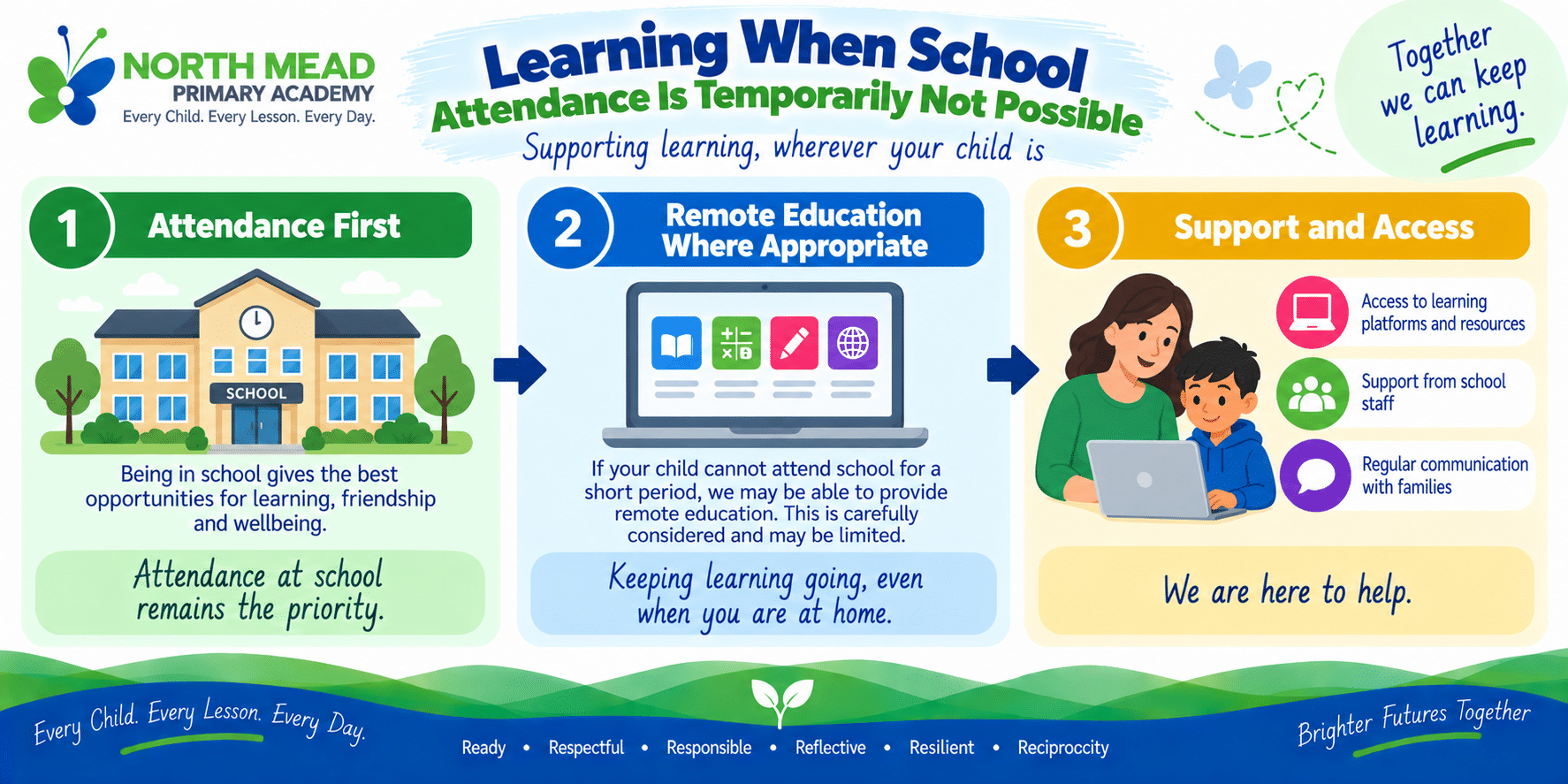
At North Mead, attendance at school is always the priority.
Children learn best when they are in school with their teachers and classmates, benefiting from direct teaching, relationships, routines and the wider life of the school.
Remote education is therefore not an alternative to attending school. It may be considered in limited circumstances where attendance is not possible, but a child is well enough to continue learning. This reflects current Department for Education guidance.
When might remote education be used?
Remote education may be considered where:
- the school is temporarily unable to open safely
- attendance has to be restricted in exceptional circumstances
- an individual pupil is temporarily unable to attend school but is well enough to learn
- a child is recovering from a short-term illness, operation or injury
- there are exceptional circumstances linked to SEND or mental health and remote education forms part of an agreed short-term plan
For individual pupils, decisions are made case by case.
Remote education should normally be a short-term measure and, where appropriate, form part of a plan to support the child’s successful return to school.
What remote education is not
Remote education is not normally provided simply because:
- a child is absent without authorisation
- a family chooses to keep a child at home
- a child is on holiday during term time
- a child is too unwell to learn
- attendance difficulties can be addressed through appropriate in-school support
Children receiving remote education because they are absent from school are still recorded as absent in accordance with attendance regulations.
What will learning look like?
Where remote education is appropriate, we aim to provide learning that connects as closely as reasonably possible with what pupils would have been learning in school.
Depending on the age, needs and circumstances of the child, this may include:
- teacher-set activities
- curriculum resources
- reading
- phonics activities
- mathematics
- writing
- wider curriculum learning
- digital learning platforms
- recorded or externally provided lessons
- tasks that can be completed away from a screen
- opportunities for feedback or communication with school
The precise provision will vary because the needs of a Reception child, for example, are very different from those of a Year 6 pupil.
Our curriculum
Remote education should support pupils to remain connected to our ambitious school curriculum.
Where possible, learning will:
- build on previous learning
- focus on important knowledge and skills
- provide clear explanations and modelling
- give pupils opportunities to practise
- allow children to apply what they have learned
- support pupils to return successfully to classroom learning
Our Learning Loop remains relevant: Retrieve → Teach & Model → Practise → Apply → Reflect
How much work will be provided?
Where a pupil is receiving a planned programme of remote education, we will consider the amount of learning that is appropriate for:
- the child’s age
- stage of development
- ability to work independently
- SEND or additional needs
- health and wellbeing
- expected length of absence
- access to technology
- the circumstances at home
DfE guidance says that, where possible, remote provision should be broadly equivalent to the core teaching time pupils would otherwise receive, while recognising individual circumstances and the need for appropriate breaks.
For primary-aged children, this does not mean spending the whole school day looking at a screen.
Digital learning
Depending on the provision agreed, pupils may use platforms available through our Pupil Portal.
These may include:
- Microsoft 365
- Microsoft Teams
- Purple Mash
- Times Tables Rock Stars
- NumBots
- Accelerated Reader
- MyON
- Lexia, where appropriate
- other curriculum resources selected by teachers
Children should use only their own login information and follow North Mead’s online-safety expectations.
Reading
Reading remains important during any period away from school.
Depending on the child, remote learning may include:
- reading an appropriate book
- phonics practice
- reading aloud
- vocabulary activities
- comprehension
- Accelerated Reader
- digital reading resources
- listening to appropriate texts
We encourage families to continue sharing books and talking about what children have read.
Pupils with SEND
Remote education must take account of individual needs.
For pupils with SEND, we may need to adapt:
- the amount of work
- instructions
- resources
- communication
- presentation
- level of adult support
- sensory demands
- use of technology
- expected outcomes
Some provision that a child receives in school cannot be replicated effectively at home.
Where a pupil has an Education, Health and Care Plan, relevant statutory responsibilities continue to apply, and school may need to work with the local authority and family to determine how needs can best be met.
Our starting point remains: What does this child need in order to succeed?
Access to technology
We recognise that families have different levels of access to:
- computers or tablets
- internet connectivity
- printers
- appropriate working spaces
If remote education has been agreed and access to technology is creating a barrier, families should speak to school.
Where possible, we will consider reasonable ways of helping the child access their learning.
Feedback and contact
The way pupils receive feedback will depend on the circumstances and length of the remote-education period.
This could include:
- feedback through an online platform
- teacher comments
- checking completed work
- communication with families
- telephone contact
- discussion when the pupil returns to school
Where remote education lasts for more than a very short period, maintaining a connection between the child and school becomes particularly important.
Safeguarding
Safeguarding remains our highest priority when pupils are learning remotely.
Children should:
- use school-approved platforms appropriately
- keep passwords private
- tell a trusted adult if something online worries them
- follow the same expectations for respectful behaviour that apply in school
The Department for Education makes clear that normal safeguarding responsibilities continue during remote education and that schools should consider pupils’ safety and wellbeing as well as their engagement with learning.
If you have a safeguarding concern about a child, please contact school directly.
- North Mead Primary Academy: 0116 276 7761 or [email protected]
- Leicester Children’s Social Care Duty and Advice: 0116 454 1004
- Immediate danger: 999
Remote education and attendance
Remote education should support a child during an unavoidable absence; it should not make prolonged absence easier to maintain.
Where attendance has become difficult, our priority is to understand the barriers and work with the child, family and relevant professionals to support a return to school.
Where remote education forms part of an individual plan, it should be:
- agreed appropriately
- time limited
- reviewed regularly
- connected to clear plans for reintegration
This is consistent with current DfE guidance.
If your child is unwell
If your child is ill, their priority should be rest and recovery.
We do not expect children who are too unwell to attend school to automatically complete a full programme of schoolwork at home.
If an absence is likely to last longer and your child is well enough to learn, please speak to us so that we can consider what provision may be appropriate.
Need support?
If remote education has been agreed for your child and you need help with:
- accessing learning
- login details
- technology
- understanding an activity
- SEND adjustments
please contact your child’s teacher or the school office.
Telephone: 0116 276 7761
Email: [email protected]
Our priority
Remote education can help children remain connected to learning during exceptional periods of absence.
But it does not replace the full experience of being in school.
Our priority remains children in school, learning with their teachers and peers, whenever they are able to attend.
Every Child. Every Lesson. Every Day.
| External Resource/Organisation | Link |
| DfE — Providing Remote Education | Providing Remote Education: guidance for schools |
| DfE — Safeguarding and Remote Education | Safeguarding and Remote Education |
| Oak National Academy | Oak National Academy |
Related North Mead Pages
- Attendance
- Pupil Portal
- Safeguarding
- SEND
- ClassDojo
- Contact Us
 Together We Make A Positive Difference