
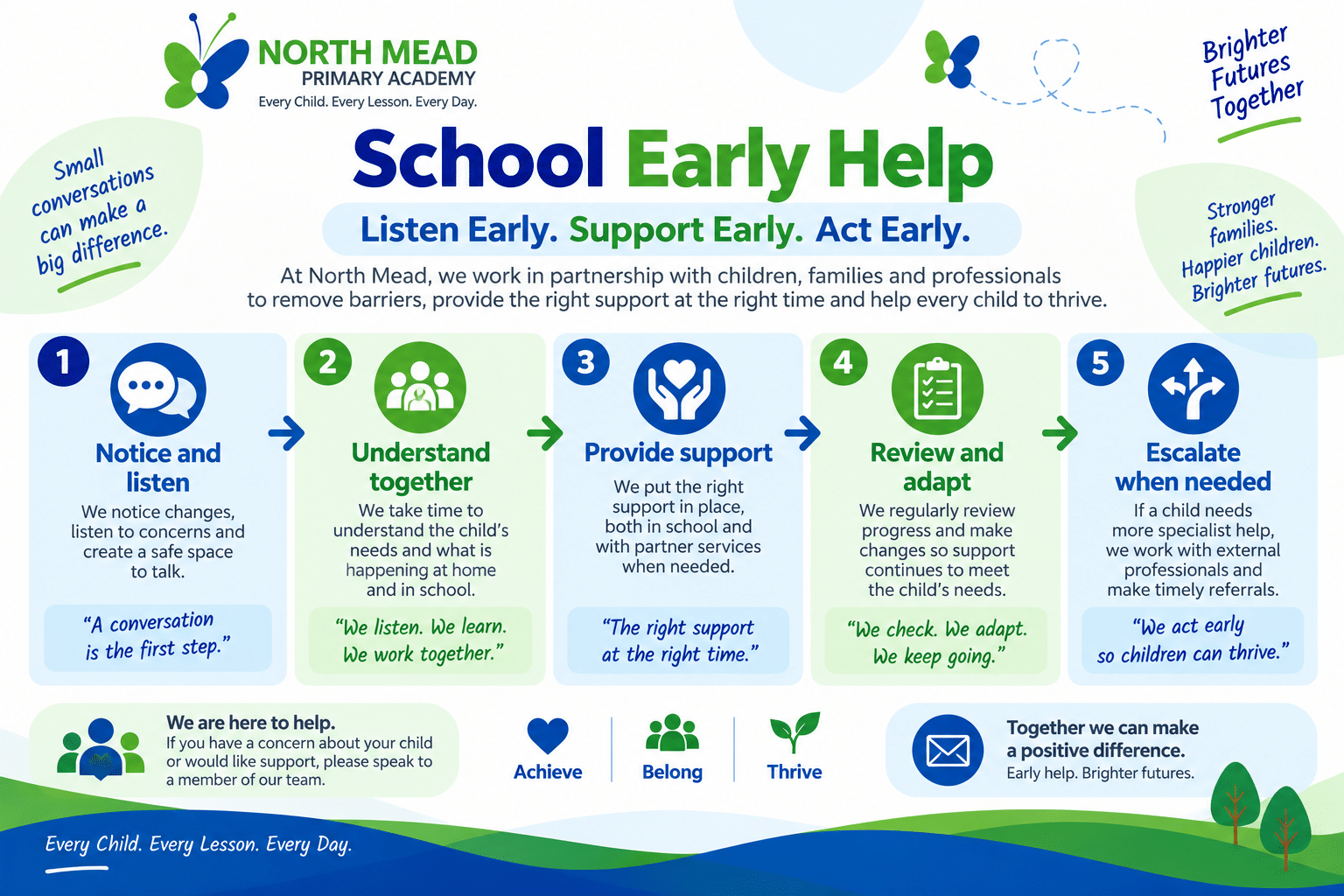
Support before difficulties become bigger
At North Mead, we know that families can need extra help at different points in a child’s life.
Sometimes the difficulty is linked to school. Sometimes it is about family life, housing, relationships, health, behaviour, attendance, finances or wellbeing. Often, several things are connected.
Our approach to Early Help is simple: Identify concerns early. Listen carefully. Bring the right people together. Take practical action. Review whether it is helping.
Early Help is about providing support as soon as difficulties begin, rather than waiting for problems to become more serious. Leicester City Council describes Early Help as support that can be offered at any stage in a child’s life and is designed to prevent difficulties from escalating.
You do not need to be in crisis to ask for help
Families can speak to us when something is beginning to feel difficult.
This might include concerns about:
- attendance or punctuality
- behaviour at home or school
- emotional wellbeing
- friendships or relationships
- parenting
- family relationships
- housing
- money or employment
- domestic abuse
- drugs or alcohol within the family
- a child’s development
- caring responsibilities
- SEND
- routines
- sleep
- bereavement or loss
- family change or separation
- access to services
- practical pressures affecting family life
Asking for help early can make it easier to find a solution before difficulties become more established.
Early Help at North Mead
Our school team can provide support directly and can also help families access other services.
Depending on the circumstances, support may involve:
- the class teacher
- Family Support Worker
- ELSA
- attendance team
- SENDCo
- pastoral staff
- safeguarding team
- Behaviour Mentor
- senior leaders
- external services
We try to avoid families having to explain the same situation repeatedly to different people.
Instead, we aim to understand the whole picture and coordinate support around the child and family.
What can school help with?
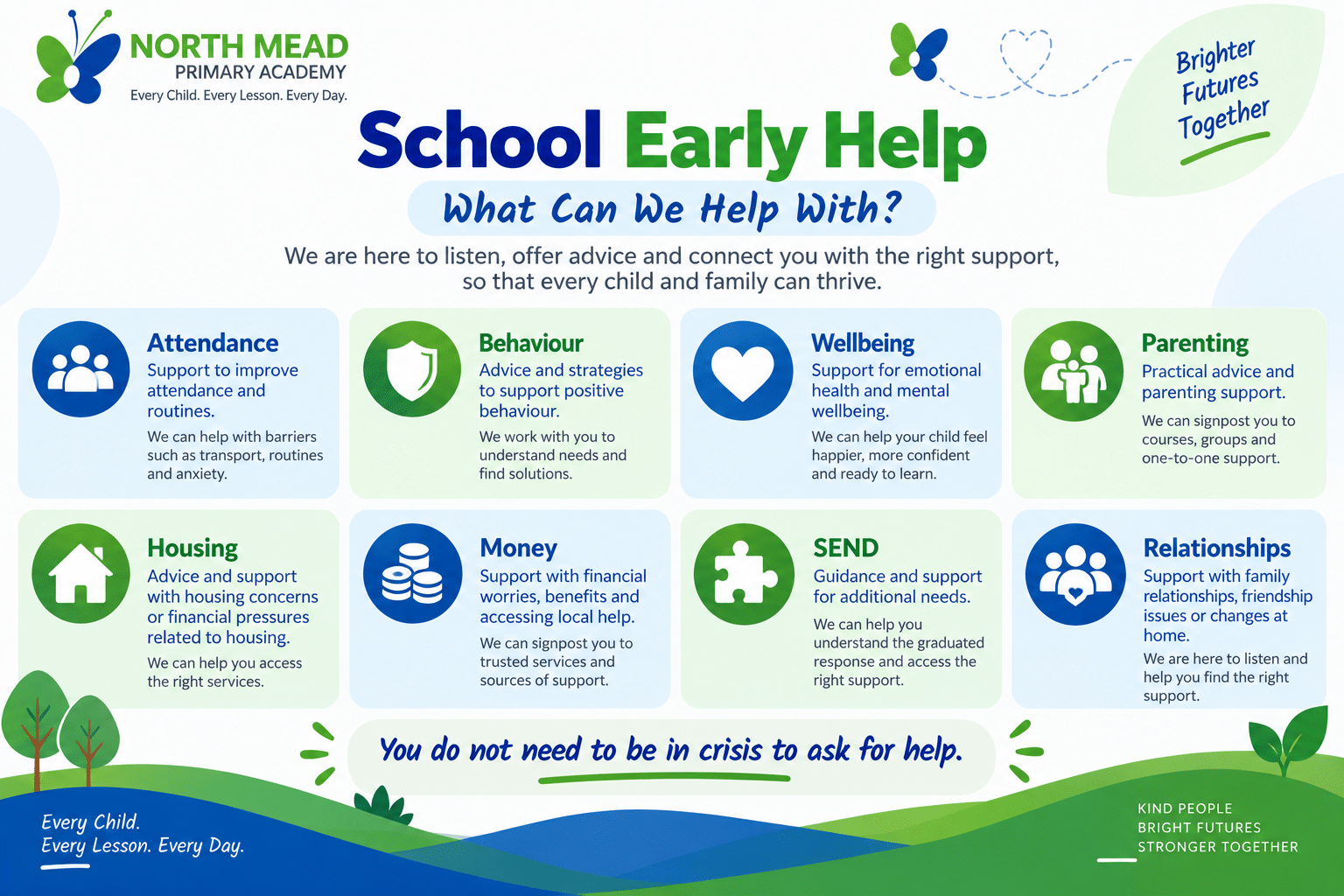
Attendance
We can work with families to understand barriers to attendance and agree practical steps to improve it.
This may include:
- attendance meetings
- individual plans
- home-school communication
- help with routines
- SEND adjustments
- pastoral support
- referrals to other services
Behaviour and routines
We can help families understand behaviour, identify possible triggers and develop consistent strategies between home and school.
Support may include:
- routines and boundaries
- emotional regulation
- communication
- relationships
- behaviour strategies
- trusted-adult support
- parenting advice
- signposting to additional services
Emotional wellbeing
Children sometimes need additional support because of anxiety, change, friendship difficulties, bereavement or other experiences.
Support may include:
- ELSA
- pastoral support
- trusted adults
- regulation strategies
- family meetings
- referrals to appropriate services
Family support
Our Family Support Worker can help families think through practical difficulties and identify appropriate sources of support.
This may include:
- parenting support
- housing or financial signposting
- family relationships
- accessing services
- form filling
- meetings
- referrals
- Early Help processes
SEND
If concerns relate to learning, communication, sensory needs, development or regulation, school may involve the SENDCo and use our graduated response.
Early Help and SEND support can work alongside each other where a family is experiencing wider difficulties.
How Early Help works
Where a family needs more coordinated support, an Early Help Assessment may be appropriate.
This helps everyone understand:
- what is going well
- what the family is worried about
- what the child needs
- what support is already in place
- what needs to change
- who will do what
- how progress will be reviewed
Leicester’s Early Help approach can involve an assessment, an agreed action plan and a Team Around the Family, bringing together the professionals who can help. Families should be involved throughout the process.
Working with families, not doing things to families
Early Help should be something we do with families.
We aim to:
- listen carefully
- understand strengths as well as difficulties
- explain what support is available
- agree priorities together
- involve families in decisions
- share information appropriately
- avoid unnecessary duplication
- review whether support is actually helping
Our focus is not simply on completing an Early Help process.
The important question is: What has changed for the child and family?
The child’s voice
Children should be involved wherever appropriate.
Depending on their age and communication needs, we may ask:
- What is going well?
- What are you worried about?
- What is difficult?
- Who helps you?
- What would you like to change?
- What would make things better?
The child’s experience should remain central to the support being planned.
School Early Help and safeguarding
Early Help is not the same as safeguarding intervention, although the two can be connected.
If we believe a child may be at risk of significant harm, we will follow our safeguarding procedures and contact Children’s Social Care where appropriate.
A safeguarding concern will not be delayed because an Early Help process is already taking place.
If you are worried that a child in Leicester may be at risk, contact the Leicester City Council Duty and Advice Service on 0116 454 1004. The service operates 24 hours a day. In an emergency, call 999.
Leicester Early Help
Families can also request Early Help directly from Leicester City Council.
Current Leicester guidance states that parents, carers, young people over 16 and professionals can request support. Leicester’s Early Help service can support areas including parenting, relationships, attendance, behaviour, emotional wellbeing, housing, money, employment and wider family circumstances.
- Telephone: 0116 454 1004
- Email for parents/carers: [email protected]
Families can also access support through Leicester’s Family Hubs, which provide advice, parenting support, family services and access to more targeted Early Help where appropriate.
Who should I speak to at North Mead?
You can speak to your child’s class teacher or contact the school office and ask to speak to a member of our Inclusion Team.
| Inclusion Team | |||||
| Mr B. Burpitt Safeguarding | Miss K. Holland SEND/Inclusion | Mrs. M. Danesh Mental Health | Mrs J. Hurst Pastoral | Mr B. Robinson Behaviour | Mrs Z. Meman Attendance |
You do not need to know exactly which person you need.
Tell us what is happening and we will help direct you to the right support.
Telephone: 0116 276 7761
Email: [email protected]
Our commitment
Asking for help is not a sign that something has failed.
Early Help is about recognising when something is becoming difficult and acting before it becomes harder to resolve.
At North Mead, we want families to know that they can speak to us early.
Listen early. Support early. Act early.
Every Child. Every Lesson. Every Day.
| External Resource/Organisation | Link |
| Leicester City Council — Early Help for Children, Young People and Families | Leicester Early Help |
| Leicester Family Hubs — Early Help Offer | Family Hubs Early Help Offer |
| Leicester Family Hubs homepage | Leicester Family Hubs |
| Leicester City Council — Children’s Social Care / Duty and Advice | Support for children and young people |
Useful Links:
NM – Inclusion and Early Help Handbook
Related North Mead Pages
- Inclusion
- SEND
- Services and Agencies
- Pastoral Support
- Attendance
- Safeguarding
- EAL
Contact Us
 Together We Make A Positive Difference