 Removing barriers and widening opportunity
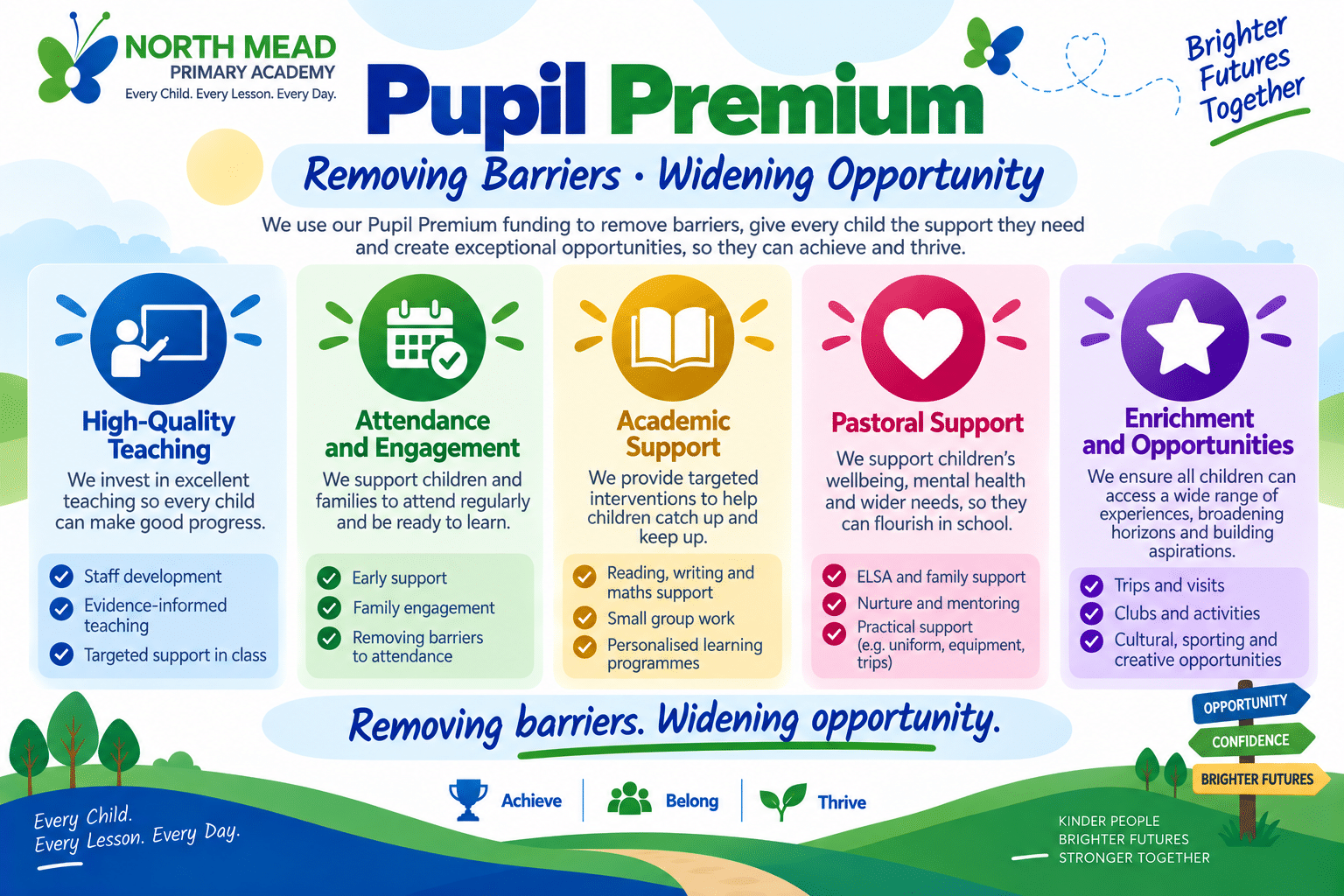
At North Mead, Pupil Premium funding is used to help ensure that disadvantage does not limit achievement, participation or aspiration.
Our approach is built around a simple principle: Every child should have access to excellent teaching, the right support and the same rich opportunities to succeed.
Pupil Premium is therefore not treated as a separate intervention programme. It is used strategically across teaching, attendance, pastoral support, inclusion, enrichment and wider school life.
Our approach
We use Pupil Premium funding to strengthen provision in the areas that make the greatest difference to pupils.
Our priorities are:
- High-quality teaching
Excellent classroom teaching has the greatest impact on disadvantaged pupils.
Funding may therefore support:
- staff development
- subject leadership
- curriculum implementation
- assessment
- intervention where gaps are identified
- resources that improve access to learning
- approaches that strengthen consistency across classrooms
- Attendance
Children cannot benefit fully from the curriculum if they are not in school.
We use funding to help identify and reduce barriers to attendance through:
- attendance support
- family work
- individual plans
- pastoral support
- home-school communication
- practical intervention
- work with external agencies where appropriate
- Academic support
Some pupils need additional teaching or targeted intervention to secure important knowledge and skills.
This may include:
- phonics
- reading
- fluency
- writing
- mathematics
- small-group teaching
- pre-teaching
- additional practice
- targeted intervention
Support is planned from identified need and reviewed for impact.
- Pastoral and family support
Disadvantage can create barriers that are not purely academic.
Funding may contribute to:
- ELSA
- Family Support Worker provision
- Behaviour Mentor support
- attendance work
- emotional regulation
- trusted-adult support
- family meetings
- referrals
- signposting
- wider early help
The aim is to help children feel safe, regulated and ready to learn.
- Enrichment and wider opportunity
At North Mead, opportunity should never depend on a family’s ability to pay.
Pupil Premium supports our wider commitment to equitable access to:
- trips
- enrichment
- Fantastic Fifty experiences
- sport
- music
- arts
- cultural experiences
- clubs
- wider opportunities
We want disadvantaged pupils to experience the same rich primary education as their peers.
Identifying barriers
Our strategy begins with understanding the specific barriers faced by our pupils.
These may include:
- gaps in prior learning
- weaker language or vocabulary
- lower reading fluency
- attendance
- family circumstances
- emotional wellbeing
- SEND
- communication needs
- limited access to wider experiences
- confidence
- transition
- instability or mobility
We do not assume that all disadvantaged pupils have the same needs.
Funding is therefore allocated according to identified barriers, not simply pupil status.
High expectations
Pupil Premium is not about lowering expectations.
We expect disadvantaged pupils to access the same ambitious curriculum as their peers.
Where support is needed, we adapt the route to success through:
- scaffolding
- modelling
- pre-teaching
- vocabulary support
- additional practice
- targeted intervention
- reasonable adjustments
- personalised pastoral support
The ambition remains high.
Reading
Reading is a central priority.
Pupil Premium may support:
- early identification of reading gaps
- Read Write Inc. intervention
- additional reading practice
- Fast Fluency
- vocabulary development
- access to high-quality books
- assessment and monitoring
- targeted support in Key Stage 2
We want disadvantaged pupils to become fluent, confident readers who can access the full curriculum.
Mathematics
Funding may support pupils who need additional help to secure:
- number sense
- calculation
- multiplication fluency
- reasoning
- problem-solving
- key mathematical vocabulary
Support is aligned with the wider Mathematics curriculum so that intervention strengthens, rather than replaces, classroom learning.
Attendance and persistent absence
Attendance is a significant part of our Pupil Premium strategy.
North Mead’s attendance has improved considerably over time, and we continue to focus on pupils whose absence risks limiting their achievement and participation.
Support may involve:
- early identification
- individual attendance plans
- family support
- pastoral intervention
- SEND adjustments
- trusted-adult support
- home visits
- external-agency involvement
We combine support with clear expectations.
SEND and disadvantage
Some pupils are both disadvantaged and have SEND.
For these pupils, we consider barriers carefully so that support is not duplicated or fragmented.
We ask:
- What is preventing this child from learning?
- Is the barrier linked to SEND, disadvantage, attendance or a combination?
- What provision will make the greatest difference?
- How will we know whether it is working?
Pupil Premium funding should complement, not replace, SEND provision.
Enrichment and cultural capital
We want children to develop knowledge of the world beyond their immediate experience.
Pupil Premium supports access to enrichment so that disadvantage does not restrict participation in:
- educational visits
- cultural experiences
- sport
- performance
- outdoor learning
- music
- art
- science experiences
- community opportunities
This links directly to our Fantastic Fifty.
Working with families
Families are important partners.
Where barriers are identified, we aim to:
- communicate early
- listen
- understand circumstances
- agree practical next steps
- provide support
- review progress
- celebrate improvement
We want families to know that support is available before difficulties become entrenched.
Evidence-informed decision-making
We use Pupil Premium strategically.
Decisions are informed by:
- assessment information
- attendance data
- pupil progress
- teacher knowledge
- pupil voice
- family information
- behaviour and pastoral information
- SEND information
- national evidence where relevant
We avoid spending simply because an approach is popular or because it has been used before.
We ask:
- What problem are we trying to solve, and is this the most effective response?
- How we evaluate impact
We evaluate whether funded approaches are improving outcomes for pupils.
This may include reviewing:
- attainment
- progress
- reading
- phonics
- mathematics
- attendance
- persistent absence
- behaviour
- engagement
- participation
- confidence
- wider opportunities
- pupil voice
- family feedback
We are particularly interested in whether barriers are reducing over time.
Our 2026 outcomes
North Mead’s wider outcomes provide important context for our disadvantaged strategy.
In 2026:
- 92% of pupils achieved the expected standard in Reading
- 83% in Writing
- 88% in Mathematics
- 81% achieved the expected standard in Reading, Writing and Mathematics combined
- whole-school attendance was 95.8%
- persistent absence was 8.2%
These whole-school outcomes do not replace group-level analysis, but they reflect the wider systems of teaching, attendance, inclusion and support within which our Pupil Premium strategy operates.
Accountability
Each year, North Mead publishes a Pupil Premium Strategy Statement setting out:
- the amount of funding received
- the key barriers identified
- the intended outcomes
- how funding is being used
- the evidence informing decisions
- how impact will be measured
- a review of the previous year’s strategy
The strategy is reviewed regularly so that spending remains focused on pupils’ current needs.
What success looks like
Our Pupil Premium strategy is successful when disadvantaged pupils are increasingly able to:
- attend school regularly
- access the full curriculum
- read fluently
- achieve well academically
- participate in enrichment
- develop confidence
- build strong relationships
- receive support early
- take part fully in school life
- leave North Mead ready for secondary education
Most importantly, we want disadvantage to have less influence over a child’s educational outcomes and opportunities.
Our commitment
Pupil Premium is not simply a funding stream.
It is part of our wider commitment to equity.
We will continue to use funding where it can make the greatest difference to achievement, attendance, inclusion, wellbeing and opportunity.
Every Child. Every Lesson. Every Day.
Pupil Premium Strategy 2025-2026 and Review 2024-2025
 Together We Make A Positive Difference