A broad, ambitious curriculum
At North Mead, children study a broad and ambitious curriculum designed to build knowledge, develop skills and help pupils understand the world around them.
Each subject has its own carefully sequenced curriculum. Learning is planned so that pupils revisit important knowledge, build on what they already know and become increasingly confident and independent as they move through school.
Our curriculum is designed around a simple question: What do we want children to know, understand and be able to do by the time they leave North Mead?
Our subjects
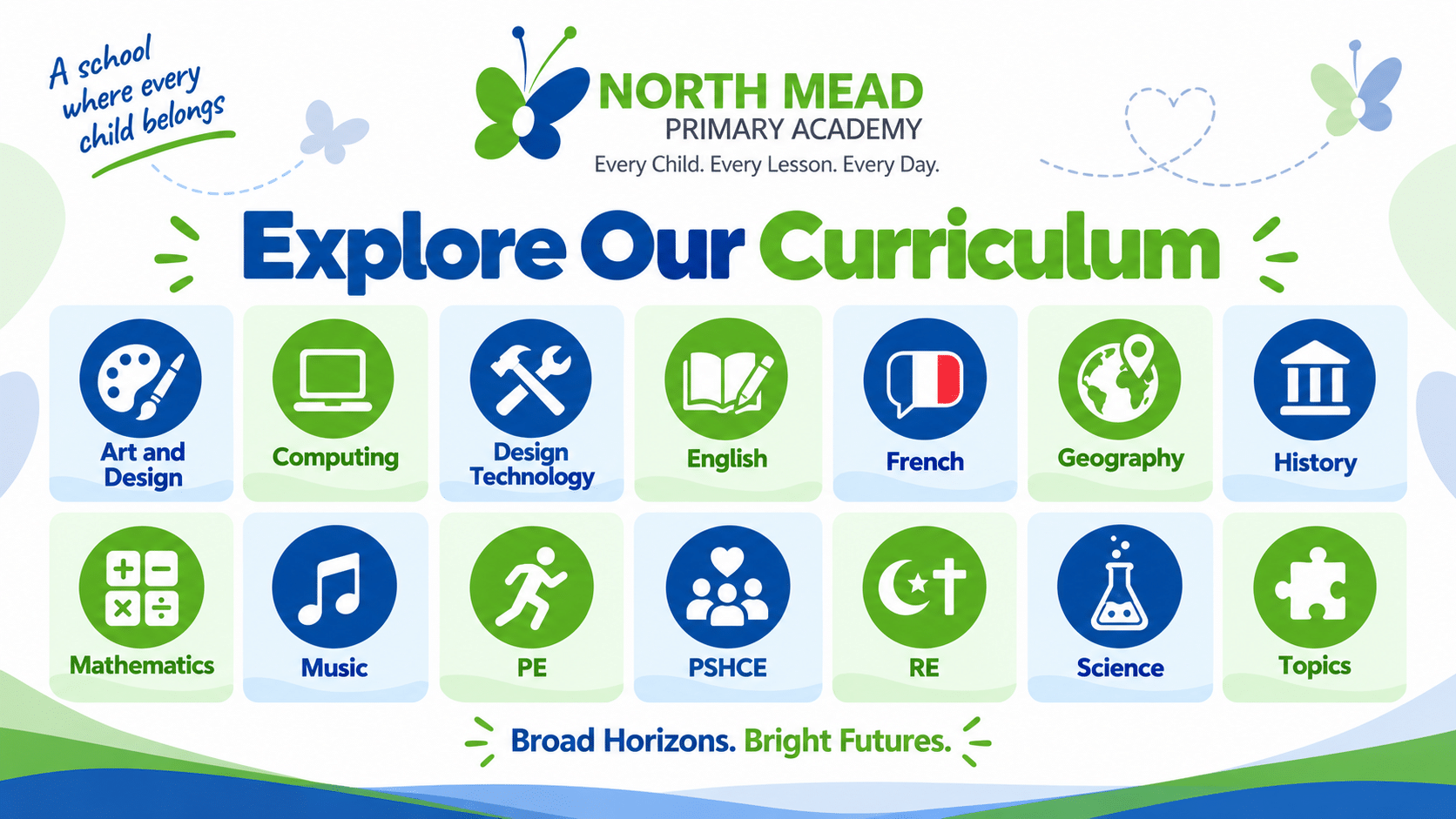
Children study the full range of curriculum subjects.
| Art and Design | Children develop confidence in drawing, painting, sculpture, print, textiles, mixed media and other creative processes. They study artists, designers and artistic traditions and learn to develop, refine and evaluate their own ideas. |
| Computing | Children learn to use technology confidently, creatively and safely. The curriculum develops understanding of computer science, information technology, digital literacy and online safety. |
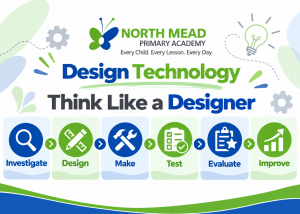
| Design Technology | Children learn to investigate, design, make and evaluate products for real purposes and users. Their learning includes structures, mechanisms, textiles, food, electrical systems and increasingly technical design processes. |
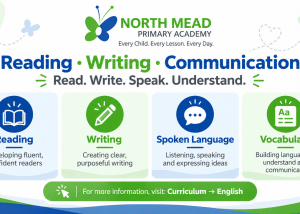
| English | English develops children’s ability to communicate, understand and express ideas.
Our English curriculum includes: · reading · writing · spoken language · vocabulary · grammar and punctuation · spelling · handwriting English is taught explicitly and is also developed across the wider curriculum. |
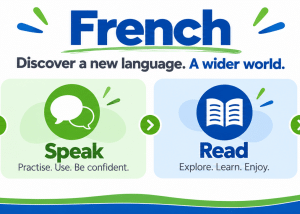
| French | From Key Stage 2, children learn French.
They develop confidence in listening, speaking, reading and writing while building vocabulary, grammar and understanding of another language and culture. |
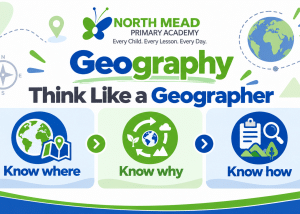
| Geography | Geography helps children understand places, people, environments and the connections between them.
Pupils develop knowledge of the local area, the United Kingdom and the wider world alongside increasingly sophisticated map, fieldwork and geographical enquiry skills. |
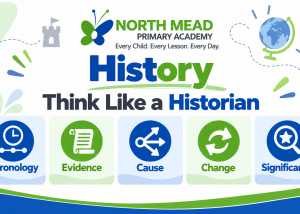
| History | History helps children understand the past and how it has shaped the world in which they live.
Pupils develop chronological knowledge and learn to think as historians by using evidence, considering cause and consequence, identifying change and continuity, and exploring historical significance and interpretation. |
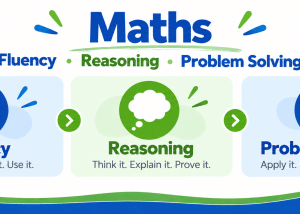
| Mathematics | Our mathematics curriculum develops secure understanding, fluency, reasoning and problem-solving.
Children learn to make connections between mathematical ideas and apply their knowledge with increasing accuracy, confidence and independence. |
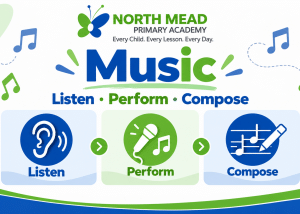
| Music | Music gives children opportunities to listen, perform, sing, compose and develop their understanding of musical language.
Children experience music from different times, places, traditions and cultures while progressively developing their own musical knowledge and skills. |
| Physical Education | PE develops physical competence, confidence, teamwork and healthy participation.
Children experience a broad range of physical activity, including games, gymnastics, dance, athletics and swimming. |
| PSHCE | PSHCE helps children develop the knowledge, understanding and skills they need to manage their lives now and in the future.
It includes learning about: · relationships · health and wellbeing · safety · citizenship · economic understanding · personal responsibility · preparation for life beyond school |
| Religious Education | RE gives pupils opportunities to explore religions and worldviews, ask important questions and develop understanding of beliefs, practices, traditions and different ways of understanding the world.
Children learn to discuss ideas respectfully and consider similarities, differences and different perspectives. |
| Science | Science helps children understand the natural and physical world.
Pupils build knowledge across biology, chemistry and physics while developing the skills of scientific enquiry, observation, investigation, comparison, measurement and explanation. |
| Topics | Our Topics page shows how selected humanities and creative subjects are brought together across the year.
The topic curriculum includes learning from: · History · Geography · Religious Education where appropriate · Art and Design · Design Technology · Each topic is built around an enquiry question and retains clear subject-specific knowledge and progression. Children encounter 36 carefully sequenced topics across Years 1–6, moving from questions about belonging and place in Year 1 to increasingly complex historical, geographical, cultural and creative enquiries in Year 6. |
Building knowledge over time
Our subject curricula are designed so that learning does not consist of isolated activities.
Children:
Retrieve what they already know
→ Learn and understand new knowledge
→ Practise important skills and ideas
→ Apply their learning
→ Reflect on what they have learned
This reflects our whole-school Learning Loop: Retrieve → Teach & Model → Practise → Apply → Reflect
As children move through North Mead, they encounter increasingly sophisticated knowledge, vocabulary, concepts and disciplinary thinking.
Vocabulary matters
Every subject has its own language.
Teachers deliberately introduce, explain and revisit important vocabulary so that children can:
- understand increasingly complex ideas
- speak confidently about their learning
- read subject-specific texts
- explain their thinking precisely
- make connections between new and previous learning
For pupils learning English as an additional language, visual support, modelling, repetition and carefully planned language development help make the curriculum accessible without reducing ambition.
Inclusive curriculum
Our ambition applies to every child.
Teachers adapt teaching and provide appropriate support so that pupils with SEND and other additional needs can participate meaningfully in the curriculum.
This may include:
- carefully selected scaffolds
- visual support
- adapted resources
- additional modelling
- pre-teaching
- communication support
- reasonable adjustments
- additional adult support
- alternative ways of recording or demonstrating learning
The aim is not simply to help children complete activities, but to enable them to learn, remember and become increasingly independent.
Beyond the classroom
Subjects are strengthened through carefully selected experiences, including:
- trips and visits
- visitors
- workshops
- fieldwork
- performances
- practical investigations
- outdoor learning
- competitions
- cultural experiences
These opportunities are planned because they deepen pupils’ knowledge and understanding.
Find out more
Use the individual subject pages to explore:
- curriculum intent
- what children learn
- progression from year to year
- key knowledge and skills
- approaches to teaching
- assessment
- enrichment and wider opportunities
Our aim is simple: Every child should experience a curriculum that is ambitious, coherent, inclusive and worth remembering.
Every Child. Every Lesson. Every Day.
 Together We Make A Positive Difference