Understanding the past to make sense of the present
At North Mead, History combines secure chronological and substantive knowledge with the disciplinary thinking pupils need to understand how historians construct accounts of the past.
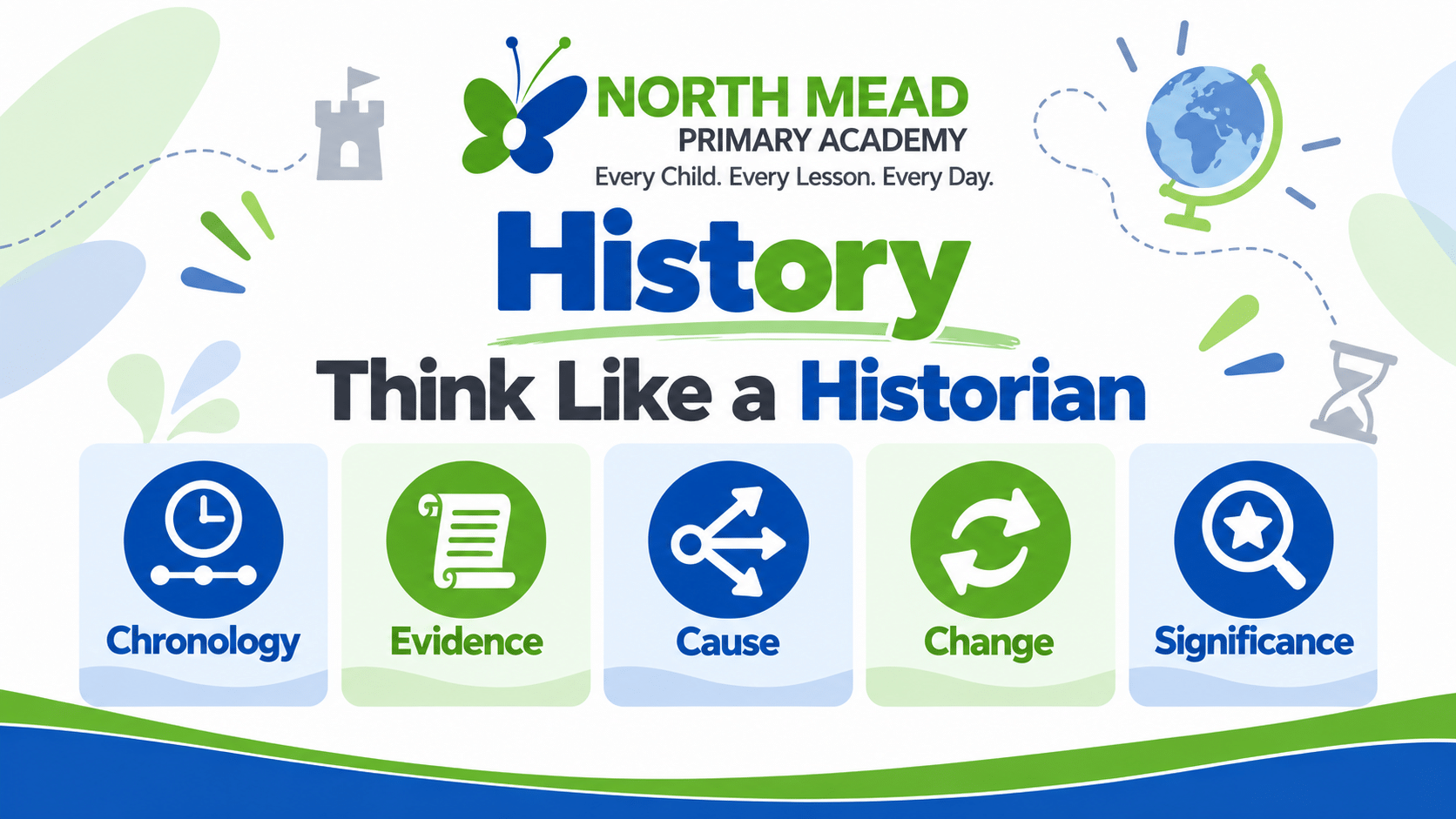
Thinking like a historian
- Chronology — when events happened and how periods fit together.
- Evidence — how sources help us know about the past.
- Cause and consequence — why events happened and what followed.
- Change and continuity — what changed, what remained and why.
- Significance and interpretation — why people and events matter and why accounts can differ.
What children learn
| Phase | What children learn |
| EYFS | Past and present through family, change over time, stories, photographs, artefacts and familiar routines. |
| KS1 | Changes within living memory; significant people, places and events; the Great Fire; beginning to use evidence and simple chronology. |
| Year 3 | Stone Age to Iron Age and Ancient Greece, building chronological frameworks and comparing societies. |
| Year 4 | Ancient Egypt, Roman Britain and local history, with increasing source analysis and explanation of change. |
| Year 5 | Anglo-Saxons and Scots, Vikings and wider themes of settlement, belief, power and migration. |
| Year 6 | Maya civilisation and a post-1066 study including Shakespeare, with greater emphasis on interpretation, significance and evidence-based conclusions. |
A connected chronology
Pupils revisit a whole-school chronology spine from Stone Age → Bronze Age → Iron Age → ancient civilisations and Greece → Romans → Anglo-Saxons and Scots → Vikings → Shakespeare and early modern Britain → modern history and the Holocaust.
Local and diverse histories
Leicester and the local area help children connect national history to places they know. Across the curriculum, pupils encounter women and men, migration, cultural diversity, Black history, empire and colonialism, and the lives of ordinary people as well as rulers and elites.
Related North Mead Pages
- Our Curriculum
- Enrichment