Ready to learn. Ready to belong.
At North Mead, we want every child to feel safe, respected and ready to learn.
Strong behaviour is not treated as something separate from learning. It is part of the culture of the school and is built through:
- clear expectations
- consistent routines
- strong relationships
- explicit teaching
- appropriate support
- calm adult responses
- recognition of positive choices
- high expectations for every child
Our aim is to create an environment in which pupils can learn successfully, build positive relationships and become increasingly responsible for their own behaviour.
Our expectations
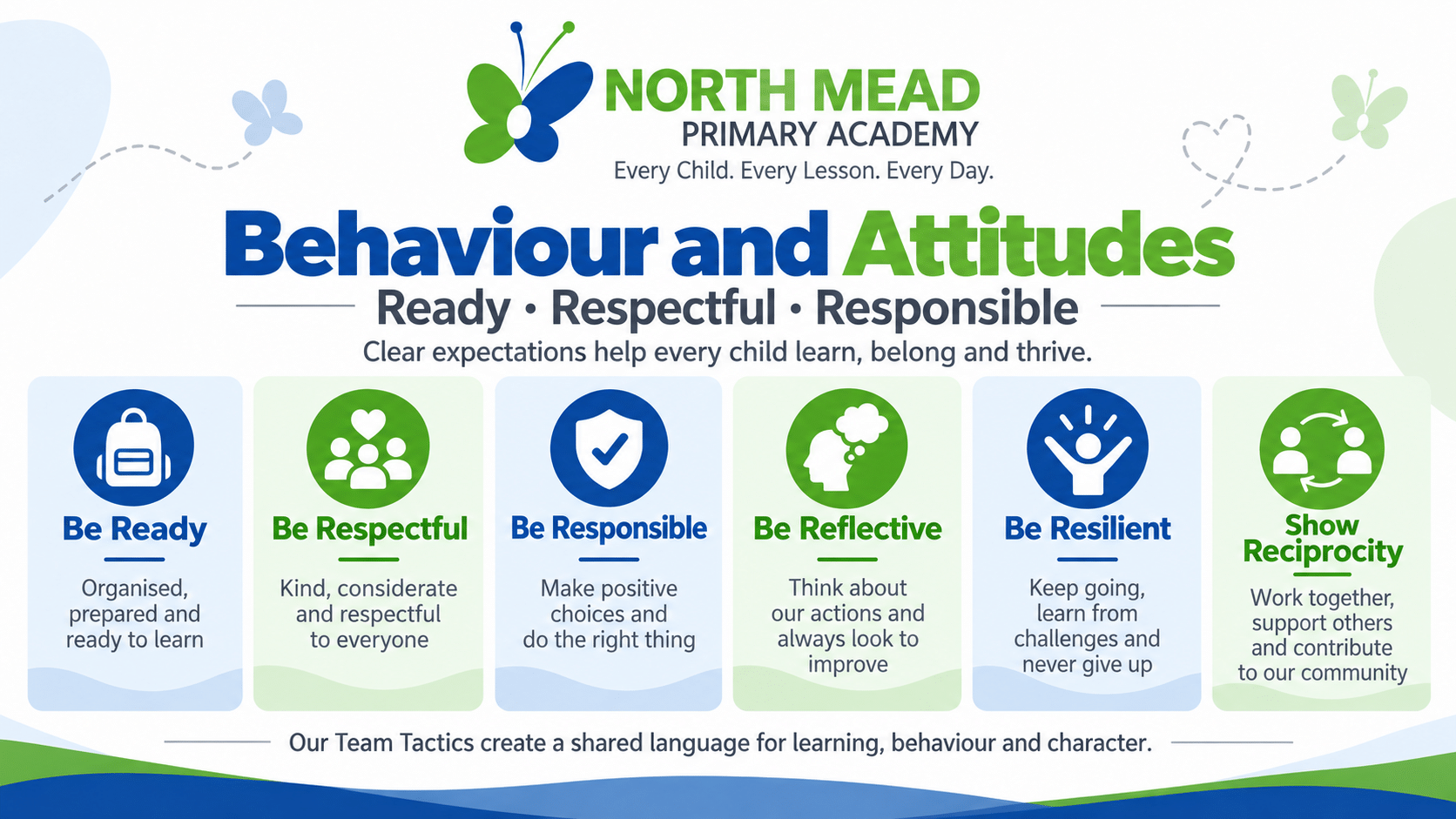
Across North Mead, we use our Team Tactics to help children understand the behaviours and learning habits we want to develop.
Children are encouraged to be:
- Be Ready
Prepared to learn and make positive choices. - Be Respectful
Kind, considerate and respectful towards others. - Be Responsible
Able to take responsibility for actions, choices and learning. - Be Reflective
Able to think about what has happened and what can be learned from it. - Be Resilient
Willing to persevere when something is difficult. - Show Reciprocity
Able to work with, support and learn alongside others.
These expectations apply in classrooms, around school, at break and lunchtime, during clubs and trips, and whenever pupils represent North Mead.
Behaviour is taught
We do not assume that every child automatically knows what successful behaviour looks like in every situation.
Adults explicitly teach, model and reinforce:
- classroom routines
- transitions
- listening
- turn-taking
- movement around school
- appropriate language
- respectful disagreement
- cooperation
- problem-solving
- managing emotions
- repairing relationships
- responding to correction
- making safer choices
Clear routines reduce uncertainty and help children understand what is expected.
High expectations and strong relationships
Positive relationships are central to our approach.
Adults know children well and aim to combine warmth with high expectations.
This means:
- noticing positive behaviour
- being clear about expectations
- responding consistently
- correcting behaviour calmly
- separating the behaviour from the child
- giving children opportunities to put things right
- helping pupils understand the impact of their choices
We want children to experience adults as predictable, fair and supportive.
Recognition and encouragement
Positive behaviour should be noticed.
Across the school, adults recognise children who demonstrate:
- effort
- kindness
- responsibility
- perseverance
- improvement
- positive learning habits
- contribution to the school community
Recognition may happen through verbal praise, classroom systems, communication with families, certificates, assemblies or other school-based approaches.
The purpose is not simply to reward compliance. It is to help children understand and internalise the behaviours that support successful learning and relationships.
When behaviour falls below expectations
When a child makes an inappropriate choice, adults respond in line with the school’s behaviour procedures.
Responses are intended to be:
- calm
- proportionate
- predictable
- fair
- focused on learning
- appropriate to the child and situation
Depending on the circumstances, this may include:
- reminders and redirection
- reteaching expectations
- restorative conversation
- loss of a privilege
- time to regulate
- additional supervision
- contact with families
- targeted support
- a formal consequence in line with school policy
Serious, persistent or unsafe behaviour is addressed appropriately and may require a more individualised plan.
Regulation and additional need
Some children need additional support to regulate emotions and behaviour.
This may include pupils with:
- SEND
- communication and interaction needs
- sensory needs
- social, emotional or mental health needs
- trauma or significant life experiences
- difficulties with change or uncertainty
Where necessary, reasonable adjustments are made so that expectations remain ambitious while support is appropriately matched to need.
Adjustments do not mean that unsafe or harmful behaviour is ignored.
They mean we consider:
- What is the child communicating?
- What support or adjustment is needed?
- How do we keep everyone safe?
- How do we help the child become increasingly successful and independent?
Restorative practice
When relationships are affected by behaviour, we want children to learn how to repair them.
Where appropriate, adults support pupils to think about:
- what happened
- who was affected
- what the impact was
- what needs to happen next
- how a similar situation could be handled differently
Restorative work does not replace consequences where these are necessary. It helps ensure that children also learn from what has happened.
Bullying
Bullying is not accepted at North Mead.
We teach children to recognise and report behaviour that is:
- deliberately harmful
- repeated
- intended to intimidate, exclude or upset
- linked to an imbalance of power
This can include verbal, physical, social or online behaviour.
Concerns are investigated and addressed in line with school policy.
We also teach children about prejudice, discrimination and protected characteristics so that they understand the importance of respect and equality.
Prejudice-related and discriminatory behaviour
Racist, homophobic, transphobic, disablist, sexist, faith-based or other discriminatory language and behaviour is not accepted.
Incidents are:
- challenged
- recorded where appropriate
- investigated
- followed up
- communicated with families where necessary
- used as an opportunity for education and reflection
Our aim is to ensure pupils understand both why the behaviour is unacceptable and what respectful behaviour looks like instead.
Working with families
Families are important partners in supporting behaviour.
Where concerns arise, we aim to:
- communicate early
- explain what has happened clearly
- listen to family perspectives
- agree practical next steps
- review support
- recognise improvement
- involve additional professionals where appropriate
The strongest outcomes are usually achieved when children experience clear and consistent expectations between home and school.
Attendance and attitudes to learning
Positive attitudes are also demonstrated through:
- regular attendance
- punctuality
- participation
- effort
- independence
- perseverance
- willingness to learn from mistakes
Good attendance and positive behaviour work together to maximise the amount of successful learning a child experiences.
Pupil voice and leadership
Children are encouraged to contribute to the culture of the school.
Through pupil leadership and wider opportunities, pupils can help:
- improve the school environment
- support younger pupils
- model expectations
- contribute ideas
- represent their peers
- take increasing responsibility
We want pupils not simply to follow expectations, but to understand why they matter.
Our aim
Ultimately, successful behaviour at North Mead is not about children behaving well only because an adult is watching.
We want pupils to develop the confidence, self-regulation and judgement to make positive choices increasingly independently.
Ready. Respectful. Responsible. Reflective. Resilient. Reciprocal.
Every Child. Every Lesson. Every Day.
Link to Behaviour Policy
Related North Mead Pages
- Personal Development
- Pastoral Support
- Attendance
- Safeguarding
- Protected Characteristics
 Together We Make A Positive Difference