English as an Additional Language
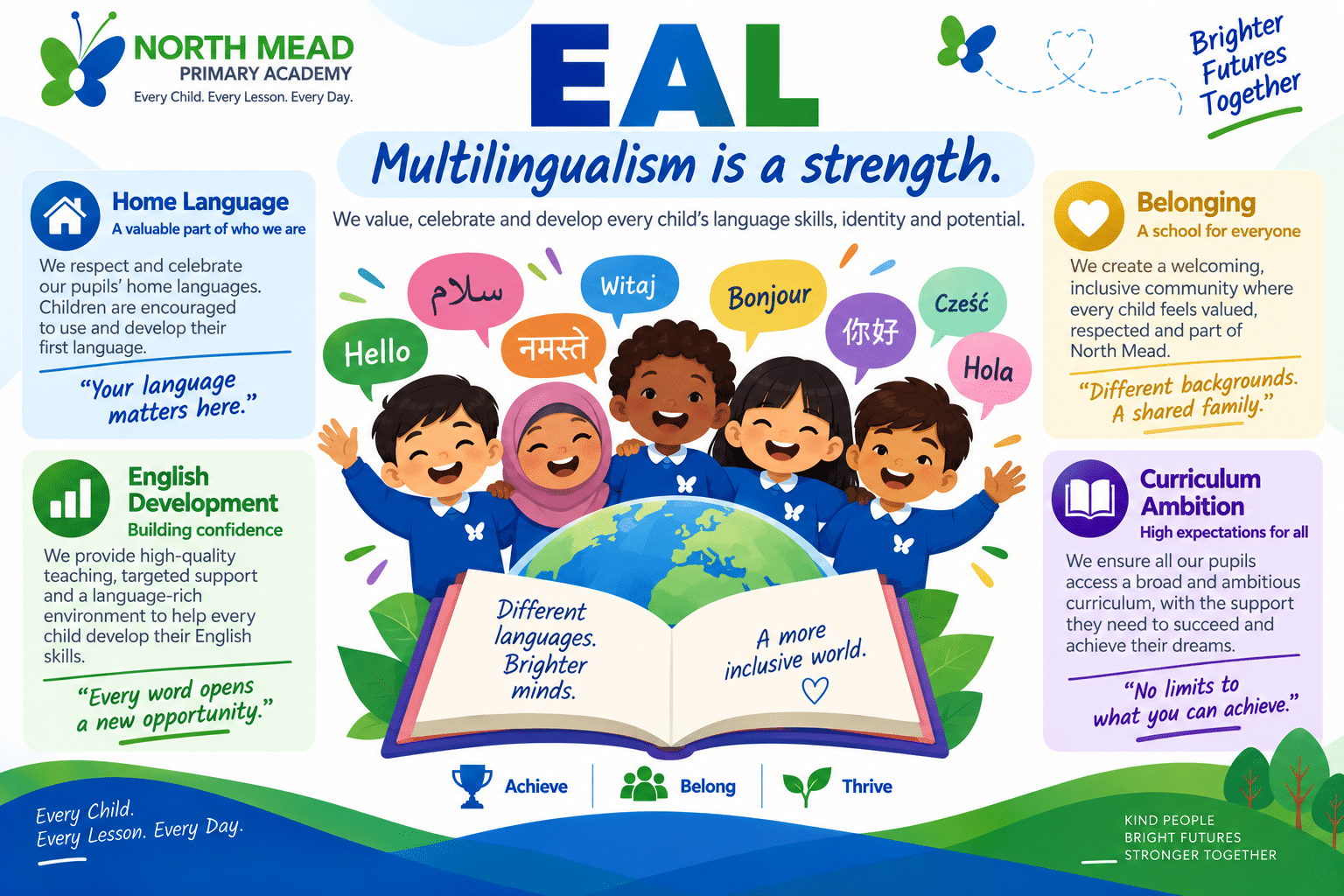
At North Mead, many children grow up using more than one language.
We see multilingualism as a strength. Children’s home languages, cultures and experiences are valued as part of our school community.
Our aim is simple: Every child should be able to understand, participate and succeed.
Children who are learning English as an additional language are expected to access the same ambitious curriculum as their peers, with appropriate support to help them develop the English they need for learning, friendships and wider school life.
Our approach
We support pupils with EAL through:
- high-quality classroom teaching
- clear routines and explanations
- explicit vocabulary teaching
- modelling of spoken and written language
- visual support
- carefully chosen scaffolds
- repetition and rehearsal
- opportunities to talk and practise language
- strong reading provision
- purposeful use of children’s prior knowledge
- close monitoring of progress
- additional support where it is needed
The goal is not to simplify learning unnecessarily. It is to make ambitious learning accessible.
New to English
Some children join North Mead with little or no spoken English.
For these pupils, our first priorities are to help them:
- feel safe and welcome
- understand important school routines
- communicate basic needs
- build relationships with adults and other children
- develop everyday spoken English
- begin accessing classroom learning
- build confidence as members of the school community
Children may initially rely on:
- gestures
- pictures and symbols
- modelling
- objects
- visual timetables
- key vocabulary
- sentence stems
- supportive peers
- bilingual resources where appropriate
Children are not expected to understand everything immediately.
Language develops over time through belonging, interaction, teaching and purposeful practice.
Developing academic English
Conversational English can develop more quickly than the language children need to succeed academically.
As pupils progress, we increasingly support them to understand and use:
- subject-specific vocabulary
- increasingly complex sentences
- explanations and reasoning
- instructions
- questions
- discussion
- written language
- technical and abstract concepts
This means EAL support is part of the whole curriculum, not something that happens only during English lessons.
Vocabulary matters
Vocabulary is particularly important for pupils learning English as an additional language.
Teachers identify and explicitly teach the words children need to understand new learning.
This may include:
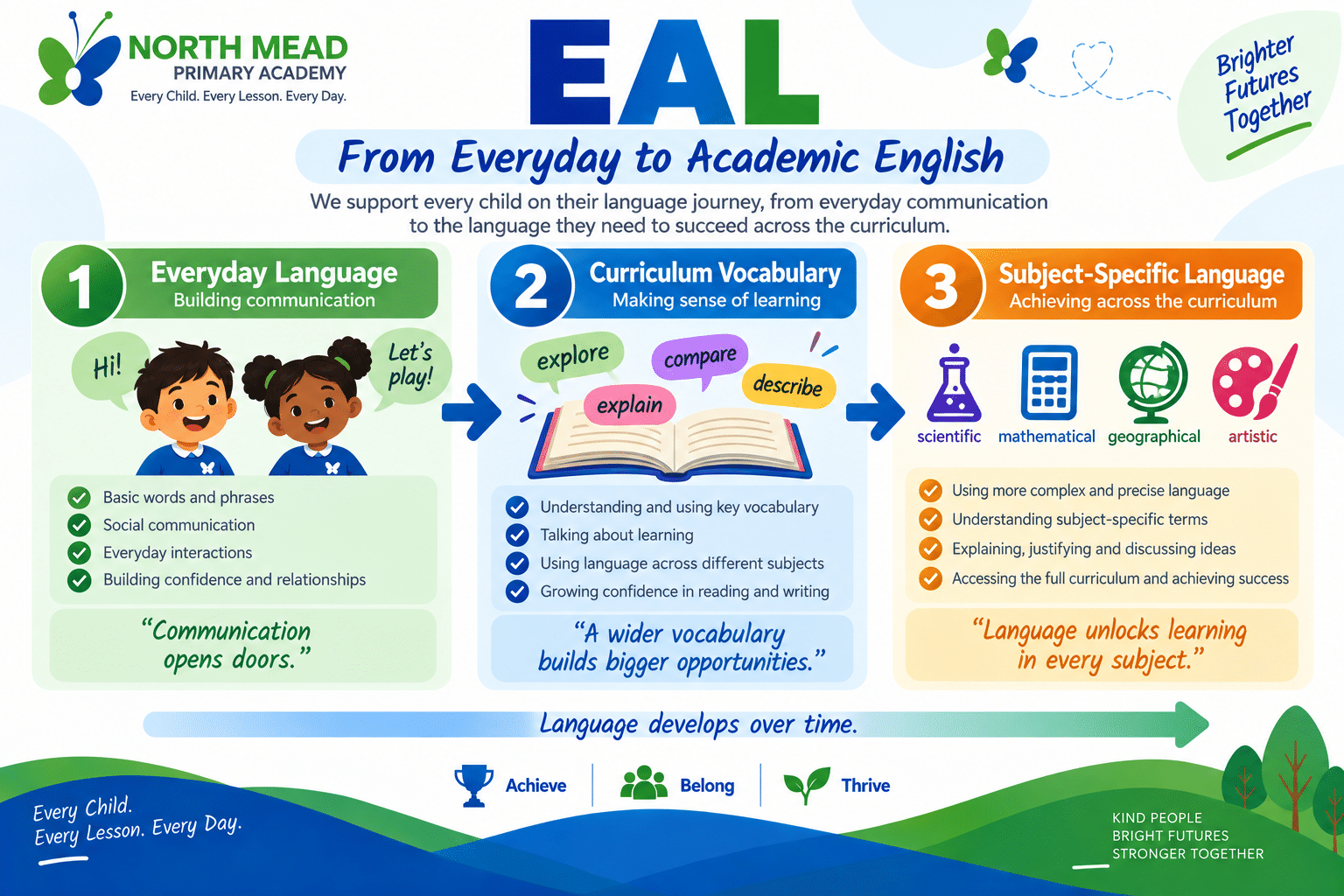
- Everyday language – Words children need for routines, relationships and communication.
- Curriculum vocabulary – Words needed to access a particular topic or lesson.
- Subject-specific vocabulary – Precise words used in subjects such as science, mathematics, geography and history.
Children are given repeated opportunities to hear, say, read and use new vocabulary in meaningful contexts.
Reading and phonics
Reading is at the heart of our curriculum.
Children with EAL access our reading provision according to their reading and language needs, rather than simply because they are learning English.
- Where appropriate, pupils access:
- systematic phonics teaching
- additional phonics practice
- fluency support
- vocabulary teaching
- comprehension support
- high-quality texts
- regular opportunities to hear adults read aloud
We recognise that a child may be able to decode words accurately while still needing additional support to understand vocabulary and meaning.
Speaking and listening
Children need frequent opportunities to hear and use English.
Across the school, adults support pupils to:
- listen carefully
- respond to questions
- rehearse answers
- explain ideas
- talk with partners
- use complete sentences
- retell and sequence
- describe
- reason
- ask questions
- take part in discussion
Oracy and interaction are central to language development.
Valuing home languages
A child’s home language is an important part of their identity and learning.
Families should continue to talk, read, tell stories and communicate with children in the language they know best.
Strong knowledge and language development in a home language can support children as they develop English.
We do not expect families to replace their home language with English.
Working with families
Clear communication with families matters.
Where possible and appropriate, North Mead uses:
- bilingual staff
- translated information
- visual information
- interpretation support
- clear explanations of school routines and expectations
- ClassDojo and other communication systems
We want families to feel able to ask questions, share information and understand how their child is progressing.
EAL and SEND
EAL is not the same as SEND.
A child should not be identified as having SEND simply because they are at an early stage of learning English.
When concerns arise, staff consider:
- the child’s English-language development
- progress over time
- prior education
- learning in their home language where information is available
- attendance
- opportunities to learn
- wider developmental information
- response to appropriate teaching and support
Some pupils may have both EAL and SEND. Where this is the case, we work carefully to understand the child’s needs and provide appropriate support.
Assessment and progress
We monitor how pupils are developing in:
- spoken English
- vocabulary
- reading
- writing
- understanding of classroom language
- participation
- curriculum learning
- independence
Assessment should help us answer:
- What can the child do now?
- What language is getting in the way?
- What do they need to learn next?
- Is our support making a difference?
Our ambition
We want pupils with EAL to do far more than simply acquire everyday English.
We want them to belong, participate, achieve and become increasingly independent learners.
Their starting point in English should never become a ceiling on what we believe they can achieve.
Every Child. Every Lesson. Every Day.
Related North Mead Pages
- Inclusion
- SEND
- Reading
- English
- Pastoral Support
- Admissions
- Services and Agencies
 Together We Make A Positive Difference