
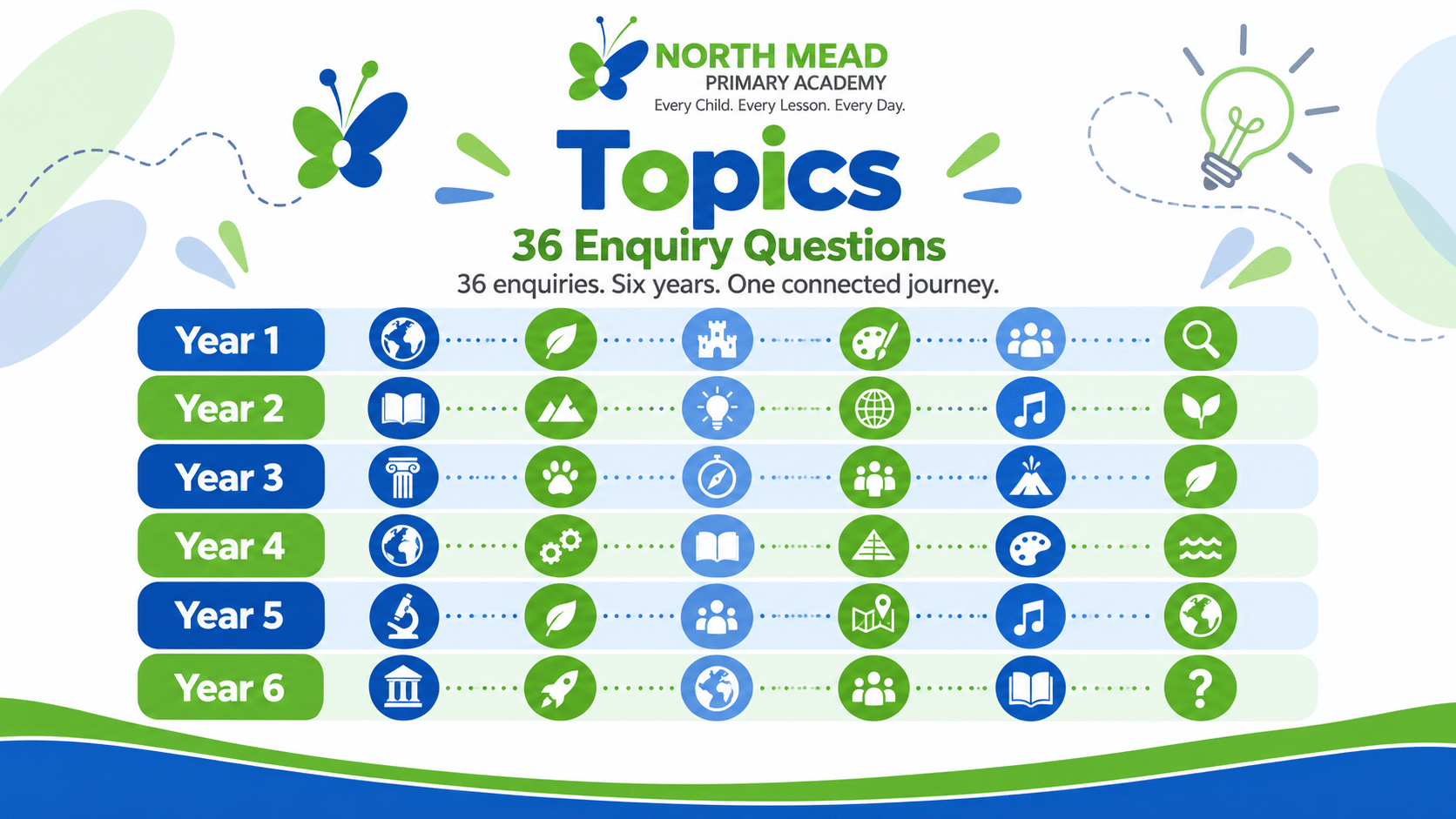
Humanities and Creative Learning at North Mead
At North Mead, our topics bring together carefully sequenced learning from the humanities and creative subjects.
Across the year, pupils explore important people, places, events, cultures, beliefs and ideas through:
- History
- Geography
- Religious Education where it forms part of the topic
- Art and Design
- Design Technology
Each topic has a clear enquiry question. The humanities learning develops subject knowledge and disciplinary thinking, while the creative element gives pupils opportunities to design, make, create, refine and evaluate.
Subjects retain their own identity and progression. The topic structure helps children make meaningful connections without turning the curriculum into a loose thematic approach.
Year 1
| Unit | Topic | Humanities focus | Creative focus |
| 1 | Where Do We Belong in the World? | Geography | Art and Design – Drawing and Mixed Media |
| 2 | What is Special About London? | Geography | Design Technology – Structures |
| 3 | What Makes a Good Community? | RE | Art and Design – Portraiture, Painting and Collage |
| 4 | How Do We Know About the Past? | History | Design Technology – Textiles |
| 5 | What is Beyond Our World? | Geography | Design Technology – Mechanisms |
| 6 | Why Should We Protect Our Oceans? | Geography | Art and Design – Sculpture |
This sequence introduces children to place, community, the past and the wider world while developing their first structured experiences of drawing, mixed media, textiles, mechanisms, structures and sculpture.
Year 2
| Unit | Topic | Creative focus |
| 1 | Why Do People Live in Different Places? | Design Technology – Structures |
| 2 | Why Did the Great Fire Spread? | Art and Design – Painting |
| 3 | How Do People Overcome Fear? | Art and Design – Drawing and Pastel |
| 4 | How Do Stories Reflect Belief? | Design Technology – Mechanisms |
| 5 | Why Are Journeys Important? | Design Technology – Food |
| 6 | Why Do Animals Need Protecting? | Art and Design – Sculpture |
The Year 2 curriculum develops pupils’ understanding of contrasting places, significant events, journeys, beliefs and the relationship between people and the natural world.
Year 3
| Unit | Topic | Creative focus |
| 1 | How Do Humans Shape Coastal Environments? | Art and Design – Drawing and Painting |
| 2 | How Does Climate Shape How People Live? | Design Technology – Textiles |
| 3 | How Did Life Change in the Stone Age? | Art and Design – Drawing and Natural Pigments |
| 4 | Why Do Oceans Matter? | Design Technology – Structures |
| 5 | How Do Journeys Transform Places? | Design Technology – Mechanisms |
| 6 | What Happens When Cultures Meet? | Art and Design – Print and Pattern |
Children begin Key Stage 2 by studying coastal environments, climate, the Stone Age, oceans, migration and cultural encounter. Creative learning becomes increasingly technical, with more deliberate use of sketchbooks, textile construction, mechanisms, structures and printmaking.
Year 4
| Unit | Topic | Creative focus |
| 1 | How Do Humans and Animals Interact? | Design Technology – Electrical Systems |
| 2 | How Do Places Shape Identity and Belief? | Art and Design – Architecture and Pattern |
| 3 | What Happened at Pompeii? | Art and Design – Mosaic |
| 4 | What is Life Like on Islands? | Design Technology – Food |
| 5 | Why Are Rainforests Important? | Art and Design – Botanical Drawing and Painting |
| 6 | How Has Our Local Area Changed? | Design Technology – Structures |
Year 4 takes pupils from conservation and Ancient Egypt through Roman Pompeii, island geography, rainforests and local history. Creative work includes electrical systems, architecture, mosaics, food, botanical art and structural design.
Year 5
| Unit | Topic | Creative focus |
| 1 | How Have People Changed the World? | Art and Design – Portraiture and Symbolism |
| 2 | What Can We Learn from Anglo-Saxons? | Design Technology – Textiles |
| 3 | What Did Vikings Believe? | Art and Design – Relief Sculpture |
| 4 | Why Is Education a Right? | Design Technology – Electrical Systems |
| 5 | How Do Humans Impact the Environment? | Design Technology – Food |
| 6 | How Does Art Express Identity and Belief? | Art and Design – Mixed Media |
Year 5 explores significant individuals, Anglo-Saxon Britain, Viking belief, rights and justice, sustainability, identity and belief. Pupils increasingly use symbolism, more accurate textile techniques, relief sculpture, electrical systems and sustainable food design.
Year 6
| Unit | Topic | Creative focus |
| 1 | What Was the Impact of the Holocaust? | Art and Design – Memorial Art and Sculpture |
| 2 | Why Should We Protect Endangered Species? | Design Technology – Electrical Systems and Programmable Control |
| 3 | What Do Stories Teach About Human Nature? | Art and Design – Figurative and Abstract Sculpture |
| 4 | How Do Humans Adapt? | Design Technology – Technical Textiles |
| 5 | Why Do People Explore? | Design Technology – Mechanical Systems |
| 6 | How Does Shakespeare Still Matter? | Art and Design – Theatre and Visual Design |
The final year of the curriculum asks pupils to engage with increasingly complex historical, geographical, ethical and cultural questions. Creative work becomes correspondingly more sophisticated, including memorial art, programmable control, abstraction, technical textiles, mechanical systems and theatre design.
Building knowledge over time
The topics are deliberately sequenced so that pupils revisit and deepen important ideas as they move through school.
In History, this includes a developing chronological understanding from changes within living memory through the Stone Age, ancient civilisations, Romans, Anglo-Saxons, Vikings, Shakespeare and modern history, including the Holocaust.
In Geography, pupils move from simple maps and observation of their local environment towards increasingly sophisticated map work, fieldwork, environmental enquiry, resource distribution, longitude, time zones and independent geographical investigation.
In Art and Design and Design Technology, pupils progress from simple drawing, joining, structures and mechanisms towards sketchbook development, technical drawing, textiles, electrical systems, programmable control, CAD where appropriate, and increasingly independent creative decision-making.
Trips, visitors and experiences
Where appropriate, topics are strengthened through:
- educational visits
- local fieldwork
- museums and galleries
- visitors and workshops
- practical projects
- performance
- outdoor learning
- cultural experiences
These experiences are chosen because they help pupils understand the curriculum more deeply.
Find out more
For more detailed information about the knowledge, skills and progression within each subject, please visit our individual curriculum pages:
History · Geography · Art and Design · Design Technology · RE
Every Child. Every Lesson. Every Day.
Year One Topic Knowledge Organisers
Year Two Topic Knowledge Organisers
Year Three Topic Knowledge Organisers
Year Four Topic Knowledge Organisers
Year Five Topic Knowledge Organisers
Year Six Topic Knowledge Organisers
Related North Mead Pages
- Our Curriculum
- History
- Geography
- Art and Design
- Design Technology
- RE
- Enrichment
- What Makes North Mead Different